
Rewired for the Kingdom

About Course

Rewired for the Kingdom

Faith and the Brain: Expert Training in Christian Neurotheology is the most advanced and comprehensive curriculum available for Christian practitioners, educators, pastors, coaches, spiritual directors, and healthcare professionals who want to integrate cutting-edge neuroscience with robust Christian theology in their work and ministry. This is not an introductory survey. It is a full professional curriculum designed to take participants to the level of genuine expert competence, capable of applying neurotheological principles with depth, nuance, and practical skill.

Over 100 full-length lessons organised across 10 intensive modules, this course covers the complete landscape of neurotheology: from the deepest theological foundations (biblical anthropology, Christology, pneumatology, ecclesiology) through advanced brain and nervous system science (functional networks, neurochemistry, polyvagal theory, neuroplasticity) to the cutting-edge research at the intersection of faith and neuroscience (prayer neuroimaging, mystical experience, health outcomes of spiritual practice). It then applies all of this to the most important and sensitive areas of human experience: trauma and healing, attachment and relationship, emotional regulation, meaning and identity, and finally to the full range of practical ministry, coaching, and educational contexts.

What sets this course apart is its integrative ambition and its refusal to let either discipline dominate the other. Neuroscience is taken with rigorous seriousness: we read the research carefully, we understand the methods and their limits, and we do not overclaim. Theology is taken with equal seriousness: we read Scripture carefully, we engage the tradition deeply, and we do not reduce faith to psychology. The result is a curriculum that produces practitioners who can speak credibly to both scientists and theologians, who can serve trauma survivors and healthy flourishers alike, and who can design formation environments that are both theologically faithful and neurologically intelligent.

This course was written in a warm, academically credible, engaging style. While the content is at an expert level, the writing invites rather than intimidates, explains rather than obscures, and consistently brings the learning back to the real human beings whose lives and faith are the whole point of this enterprise. Every module includes full lesson texts, 8 to 10 activities and exercises, multiple choice assessments, and true-false assessments. You will be challenged, stretched, and equipped. And if you engage fully with the material, you will be transformed.

If you find this course helpful, please consider leaving us a rating.

“If you’re interested in the science behind learning and faith, you might also like our Neuroscience & Cognitive Studies courses.”

Your next course is waiting:

Step 1: Faith and the Transformed Brain
Align your thoughts with truth and renew your mind.

Step 2: Where Brain Science Meets Discipleship
Live it. Walk it. Teach it.

Step 3: Rewired for the Kingdom
Break old patterns. Discover who you are in Christ.

Show More

What Will You Learn?

  • • Apply a sophisticated, non-reductive theological anthropology to neuroscientific findings about the brain, mind, and soul
  • • Demonstrate mastery of advanced brain anatomy, functional networks, neurochemistry, polyvagal theory, and research methodology
  • • Critically evaluate neurotheology research, including landmark studies and their limitations
  • • Explain the neuroscience of prayer, worship, mystical experience, and contemplative practice with academic accuracy
  • • Apply neuroplasticity principles to design evidence-informed discipleship and spiritual formation pathways
  • • Use attachment theory and relational neuroscience to understand and support people's relationships with God and community
  • • Practice trauma-informed ministry and coaching with genuine neurobiological and theological literacy
  • • Support emotional regulation through neurologically grounded spiritual practices across diverse nervous system states
  • • Help individuals and communities inhabit truer, more life-giving narrative identities rooted in the gospel
  • • Navigate the philosophy of mind, faith-science models, and worldview integration with intellectual integrity
  • • Design, deliver, and evaluate professional neuro-faith interventions for individuals, groups, and congregations
  • • Build and sustain an ethical, boundaried, collaborative professional practice in ministry or coaching

Course Content

MODULE 1 THEOLOGICAL FOUNDATIONS FOR NEUROTHEOLOGY
Module Introduction Welcome to Module 1! Before we ever open a neuroscience textbook, we need a solid theological floor beneath our feet. Neurotheology, at its best, is a respectful conversation between two disciplines that each has enormous things to say about human beings. Theology asks: Who are we before God? Neuroscience asks: How do our brains give rise to experience? This module gives you the theological vocabulary and framework you need to engage that conversation with depth, confidence, and integrity. Think of it as building your theological toolbox before you begin the lab work. Module Learning Objectives • Demonstrate expert-level understanding of the theological and neuroscientific content presented in this module • Apply the module's key concepts to real-world ministry, coaching, and formation contexts • Critically evaluate relevant research and literature with appropriate methodological and theological discernment • Integrate the module's content with learning from previous and subsequent modules to build a coherent neurotheological framework • Engage the module's activities and assessments to consolidate and extend personal and professional growth

  • LESSON 1.1: BIBLICAL ANTHROPOLOGY: BODY, SOUL, SPIRIT
  • LESSON 1.2: MIND, HEART, AND WILL IN SCRIPTURE
  • LESSON 1.3: CREATION, FALL, AND REDEMPTION AS A FRAMEWORK
  • LESSON 1.4: FAITH, DOUBT, AND LAMENT IN THE BIBLICAL STORY
  • LESSON 1.5: THE TRINITY AND RELATIONAL ONTOLOGY
  • LESSON 1.6: CHRISTOLOGY: PERSON AND WORK OF CHRIST
  • LESSON 1.7: PNEUMATOLOGY: THE HOLY SPIRIT AND TRANSFORMATION
  • LESSON 1.8: ECCLESIOLOGY: CHURCH AS A FORMATIONAL COMMUNITY
  • LESSON 1.9: ESCHATOLOGY, HOPE, AND ULTIMATE HEALING
  • LESSON 1.10: THEOLOGICAL PITFALLS IN TALKING ABOUT THE BRAIN
  • Brain Exercise 1: The Dual-Encoding Anthropology Practice
  • Brain Exercise 2: Polyvagal State Tracking Through Theological Reflection
  • Brain Exercise 3: The Lament Brain Reset
  • Scripture Meditation 1: Psalm 139:1-18 | Lectio Divina
  • Scripture Meditation 2: Genesis 2:4b-7 | Imaginative Prayer
  • Journaling Prompt 1: My Implicit Anthropology
  • Journaling Prompt 2: When the Brain Troubles Me
  • Journaling Prompt 3: The Fall and My Brain
  • Journaling Prompt 4: Doubt as Spiritual Courage
  • Journaling Prompt 5: The Trinity and My Relationships
  • MODULE 1 ASSESSMENT

MODULE 2 ADVANCED BRAIN AND NERVOUS SYSTEM FOUNDATIONS
Module Introduction Welcome to Module 2! If Module 1 built our theological foundation, this module gives us the neuroscientific ground floor. Understanding the brain is not just academic preparation for the neurotheologian. It is an act of reverent attention to the extraordinary organ through which God works in human beings. Think of this module as learning the instrument before you play the music. We will move through brain anatomy, functional networks, neurochemistry, memory, the nervous system, and developmental neuroscience, all through a lens that is both academically rigorous and pastorally relevant. Module Learning Objectives • Demonstrate expert-level understanding of the theological and neuroscientific content presented in this module • Apply the module's key concepts to real-world ministry, coaching, and formation contexts • Critically evaluate relevant research and literature with appropriate methodological and theological discernment • Integrate the module's content with learning from previous and subsequent modules to build a coherent neurotheological framework • Engage the module's activities and assessments to consolidate and extend personal and professional growth

MODULE 3 NEUROTHEOLOGY AND RESEARCH ON SPIRITUAL PRACTICES
Module Introduction Welcome to Module 3! This is where theology and neuroscience explicitly meet in the field of neurotheology itself. How does prayer change the brain? What happens neurologically during worship? What can we learn, and what must we be careful not to over-claim, from neuroimaging studies of spiritual experience? This module surveys the history, methodology, landmark studies, and ongoing debates in neurotheology research, equipping you to engage this literature with both enthusiasm and rigorous discernment. Module Learning Objectives • Demonstrate expert-level understanding of the theological and neuroscientific content presented in this module • Apply the module's key concepts to real-world ministry, coaching, and formation contexts • Critically evaluate relevant research and literature with appropriate methodological and theological discernment • Integrate the module's content with learning from previous and subsequent modules to build a coherent neurotheological framework • Engage the module's activities and assessments to consolidate and extend personal and professional growth

MODULE 4 NEUROPLASTICITY, FORMATION, AND DISCIPLESHIP
Module Introduction Welcome to Module 4! This is one of the most practically transformative modules in the entire course, because it is here that the science of brain change meets the ancient tradition of Christian formation. Neuroplasticity, the brain's remarkable capacity to change its structure and function in response to experience, is the neuroscientific foundation for everything we believe about growth, transformation, and the renewing of the mind. In this module, we will explore how the brain changes, why spiritual disciplines work, and how to design formation pathways that are both theologically sound and neurologically intelligent. Module Learning Objectives • Demonstrate expert-level understanding of the theological and neuroscientific content presented in this module • Apply the module's key concepts to real-world ministry, coaching, and formation contexts • Critically evaluate relevant research and literature with appropriate methodological and theological discernment • Integrate the module's content with learning from previous and subsequent modules to build a coherent neurotheological framework • Engage the module's activities and assessments to consolidate and extend personal and professional growth

MODULE 5 ATTACHMENT, RELATIONAL NEUROSCIENCE, AND GOD
Module Introduction Welcome to Module 5! Few areas of neurotheology are as practically powerful, personally challenging, or pastorally significant as the intersection of attachment theory and our relationship with God. How we learned to relate to our earliest caregivers shapes, in profound ways, how we relate to God, how we engage with faith communities, and how we experience the presence and character of God. This module explores attachment theory in depth, examines the research on attachment to God, and draws out the rich practical implications for pastoral care, spiritual direction, coaching, and community life. Module Learning Objectives • Demonstrate expert-level understanding of the theological and neuroscientific content presented in this module • Apply the module's key concepts to real-world ministry, coaching, and formation contexts • Critically evaluate relevant research and literature with appropriate methodological and theological discernment • Integrate the module's content with learning from previous and subsequent modules to build a coherent neurotheological framework • Engage the module's activities and assessments to consolidate and extend personal and professional growth

MODULE 6 TRAUMA, SHAME, AND SPIRITUAL ABUSE
Module Introduction Welcome to Module 6. This is perhaps the most sensitive and most urgently needed module in this entire curriculum. Trauma, shame, and spiritual abuse are realities that touch the lives of an alarming proportion of the people who walk through the doors of our churches, sit in our coaching sessions, and seek our pastoral care. Understanding these realities through both the lens of neurobiology and the lens of theology is not optional for the credible neurotheological practitioner. It is a moral responsibility. Module Learning Objectives • Demonstrate expert-level understanding of the theological and neuroscientific content presented in this module • Apply the module's key concepts to real-world ministry, coaching, and formation contexts • Critically evaluate relevant research and literature with appropriate methodological and theological discernment • Integrate the module's content with learning from previous and subsequent modules to build a coherent neurotheological framework • Engage the module's activities and assessments to consolidate and extend personal and professional growth

MODULE 7 EMOTION, REGULATION, AND SPIRITUAL PRACTICES
Module Introduction Welcome to Module 7! Emotions are not obstacles to spiritual life; they are integral to it. The psalms are saturated with emotion. Jesus wept, rejoiced, agonised, and marvelled. The spiritual disciplines have always been, in part, practices for cultivating a healthy and honest emotional life. This module explores emotion from both neurobiological and theological perspectives, examines how spiritual practices support regulation, and equips practitioners to design emotionally intelligent ministry environments. Module Learning Objectives • Demonstrate expert-level understanding of the theological and neuroscientific content presented in this module • Apply the module's key concepts to real-world ministry, coaching, and formation contexts • Critically evaluate relevant research and literature with appropriate methodological and theological discernment • Integrate the module's content with learning from previous and subsequent modules to build a coherent neurotheological framework • Engage the module's activities and assessments to consolidate and extend personal and professional growth

MODULE 8 MEANING, STORY, AND IDENTITY IN CHRIST
Module Introduction Welcome to Module 8! Human beings are meaning-making, story-living creatures. We understand ourselves, our relationships, and our world through narrative, and the stories we inhabit shape everything: our emotions, our choices, our possibilities, and our experience of God. This module explores the deep connections between the brain's narrative systems, the Christian understanding of identity in Christ, and the practical work of supporting people to inhabit truer, richer, more life-giving stories. Module Learning Objectives • Demonstrate expert-level understanding of the theological and neuroscientific content presented in this module • Apply the module's key concepts to real-world ministry, coaching, and formation contexts • Critically evaluate relevant research and literature with appropriate methodological and theological discernment • Integrate the module's content with learning from previous and subsequent modules to build a coherent neurotheological framework • Engage the module's activities and assessments to consolidate and extend personal and professional growth

MODULE 9 FAITH, SCIENCE, AND WORLDVIEW INTEGRATION
Module Introduction Welcome to Module 9! This module addresses one of the most important intellectual challenges facing the Christian neurotheologian: how do we relate the claims of neuroscience and the claims of faith in a way that is both intellectually honest and theologically faithful? How do we read and communicate neuroscience accurately? How do we navigate popular myths, philosophical debates, and the fascinating ethical frontiers opened up by emerging technology? This is the module that equips you to think and speak clearly in the spaces where faith and science meet. Module Learning Objectives • Demonstrate expert-level understanding of the theological and neuroscientific content presented in this module • Apply the module's key concepts to real-world ministry, coaching, and formation contexts • Critically evaluate relevant research and literature with appropriate methodological and theological discernment • Integrate the module's content with learning from previous and subsequent modules to build a coherent neurotheological framework • Engage the module's activities and assessments to consolidate and extend personal and professional growth

MODULE 10 PRACTICE, COACHING, AND MINISTRY DESIGN
Module Introduction Welcome to Module 10! This is where everything comes together. After nine modules of deep theological, neuroscientific, and integrative learning, we arrive at the most practically focused module in the curriculum: the application of neurotheological expertise to real-world practice, coaching, ministry design, and professional development. This module is designed to equip you not just with knowledge but with the professional competencies, ethical frameworks, and practical tools you need to work effectively and sustainably in the faith-brain space. Module Learning Objectives • Demonstrate expert-level understanding of the theological and neuroscientific content presented in this module • Apply the module's key concepts to real-world ministry, coaching, and formation contexts • Critically evaluate relevant research and literature with appropriate methodological and theological discernment • Integrate the module's content with learning from previous and subsequent modules to build a coherent neurotheological framework • Engage the module's activities and assessments to consolidate and extend personal and professional growth

Earn a certificate

Add this certificate to your resume to demonstrate your skills & increase your chances of getting noticed.
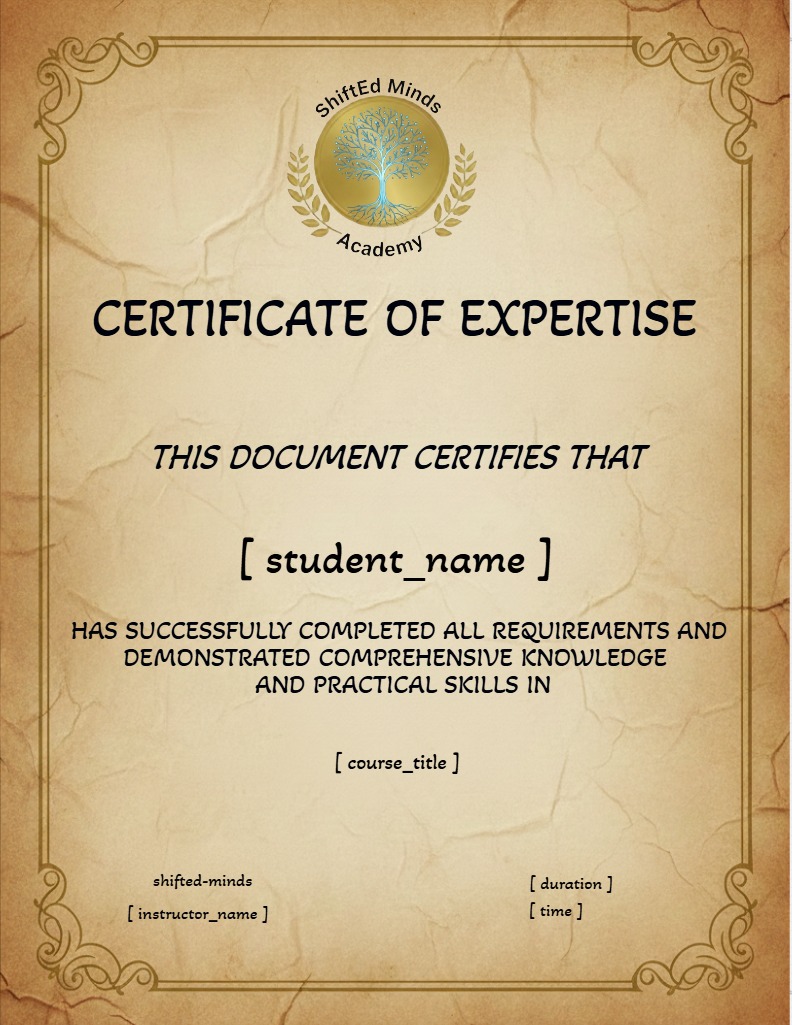
selected template

Student Ratings & Reviews

No Review Yet
No Review Yet
Scroll to Top