
Trauma-Informed Education: Neuroscience for Practitioners
About Course

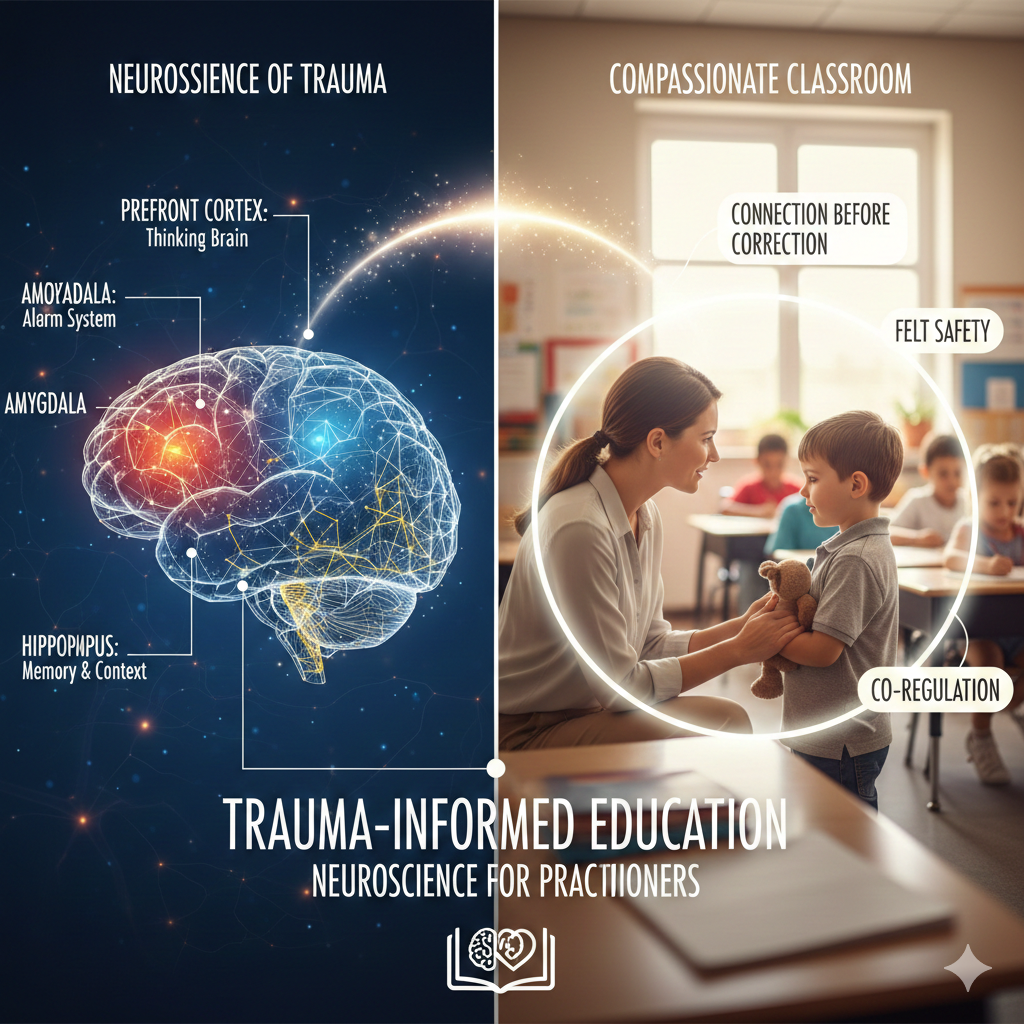
This intermediate-level course provides educators and care professionals with a comprehensive understanding of how trauma impacts learning, behavior, and development through a neuroscience lens. Grounded in current research and practical application, this course reframes challenging behaviors as adaptive nervous system responses rather than deficits or defiance. You’ll explore the neurobiology of trauma, attachment theory, co-regulation strategies, and evidence-based interventions that create safe, supportive learning environments. This course bridges scientific knowledge with compassionate practice, empowering you to support learners who have experienced adversity while fostering resilience and growth.

We’d love your feedback 

If this course supported your growth or sparked new insights, please take a moment to leave us a review on Google.

Your words help others find us, and help us keep creating meaningful, stigma-free learning experiences.

Leave a review here

Show More

What Will You Learn?

  • • Understand the neurobiology of trauma and its impact on learning and behavior
  • • Recognize trauma responses as adaptive survival mechanisms rather than willful misbehavior
  • • Implement trauma-informed teaching strategies that support nervous system regulation
  • • Apply co-regulation techniques to help learners develop self-regulation skills
  • • Create psychologically safe learning environments that promote healing and growth
  • • Identify and respond to signs of trauma in educational and care settings
  • • Develop individualized support plans based on neurological understanding
  • • Use restorative practices instead of punitive discipline approaches
  • • Build secure relationships that foster attachment and trust
  • • Integrate sensory regulation strategies into daily practice
  • • Understand the window of tolerance and how to support optimal arousal states
  • • Apply culturally responsive trauma-informed practices
  • • Collaborate effectively with families and interdisciplinary teams
  • • Recognize and prevent secondary traumatic stress and burnout
  • • Advocate for systemic changes that support trauma-informed care

Course Content

Module 1: Understanding Trauma Through a Neuroscience Lens
Module Learning Objectives • Define trauma from neurobiological and psychological perspectives • Explain the stress response system and its role in survival • Identify different types of trauma and their potential impacts • Understand how trauma affects brain development and function • Recognize the prevalence of trauma in educational settings

  • Lesson 1.1: What is Trauma? Reframing Our Understanding
  • Lesson 1.2: The Neurobiology of the Stress Response
  • Lesson 1.3: Types of Trauma and Their Impacts on Development
  • Questions 1
  • Module 1: Activities & Exercises

Module 2: The Impact of Trauma on Learning and Behavior
Module Learning Objectives • Explain how trauma affects executive functions and academic performance • Identify behavioral manifestations of trauma in educational settings • Understand the connection between trauma and learning difficulties • Recognize the role of memory in trauma responses • Distinguish between trauma responses and other learning or behavioral challenges

Module 3: Building Trauma-Informed Relationships
Module Learning Objectives • Understand the central role of relationships in healing from trauma • Apply attachment theory to educational and care settings • Develop skills in empathetic listening and validation • Create conditions for trust-building with trauma-affected learners • Recognize and repair relationship ruptures effectively

Module 4: Creating Trauma-Sensitive Environments
Module Learning Objectives • Design physical spaces that promote safety and regulation • Develop classroom and organizational cultures that support trauma healing • Implement effective routines, structures, and transitions • Create predictability while maintaining necessary flexibility • Address environmental triggers and sensory considerations

Module 5: Co-Regulation and Teaching Self-Regulation
Module Learning Objectives • Understand the neuroscience and process of co-regulation • Implement effective co-regulation strategies in various situations • Incorporate sensory regulation tools and approaches • Teach self-regulation skills explicitly and developmentally • Support students in developing their own regulation toolbox

Module 6: Trauma-Informed Instruction and Accommodation
Module Learning Objectives • Adapt instructional approaches to support regulated learning • Implement academic accommodations for trauma-affected learners • Apply strength-based and asset-focused instructional practices • Support executive function development through instruction • Create trauma-sensitive assessment and evaluation practices

Module 7: Collaboration, Self-Care, and Systems Change
Module Learning Objectives • Collaborate effectively with families and interdisciplinary teams • Recognize and prevent secondary traumatic stress and burnout • Develop personal self-care and sustainability practices • Advocate for trauma-informed systems and policy changes • Support organizational culture change toward trauma-informed practice

Earn a certificate

Add this certificate to your resume to demonstrate your skills & increase your chances of getting noticed.
selected template

Student Ratings & Reviews

No Review Yet
No Review Yet
Scroll to Top