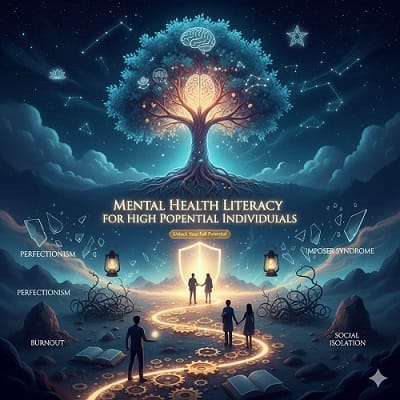
Mental Health Literacy for High Potential Individuals
About Course
Mental Health Literacy for High-Potential Individuals
It is a 9-module, expert-level academic course designed to foster deep understanding and practical competence in mental health literacy amongst high-potential individuals (HPIs). The course is grounded in current mental health literacy frameworks and evidence-based research relevant to both gifted youth and adults, synthesizing key insights from psychology, education, and neuroscience.
This course is tailored to the unique cognitive, emotional, and psychosocial landscapes of HPIs, addressing prevalent mental health challenges such as perfectionism, imposter syndrome, burnout, and social isolation, while empowering learners to recognize, manage, and advocate for mental well-being in themselves and others. Each module offers a series of engaging, academically rigorous lessons accompanied by real-world case studies, reflective activities, and assessment items designed according to best practices in curriculum design.
The content draws on internationally recognized evidence-based mental health curricula, expert guidelines specific to high-potential populations, and current theories in educational and clinical psychology. Warm and accessible in tone while retaining intellectual rigor, the course is ideal for advanced learners, educators, clinicians, and HPIs seeking to enhance both their knowledge and practical mental health competencies.
We’d love your feedback
If this course supported your growth or sparked new insights, please take a moment to leave us a review on Google.
Your words help others find us, and help us keep creating meaningful, stigma-free learning experiences.
What Will You Learn?
- • Explain and critically evaluate key frameworks of mental health literacy, including their application to high potential populations.
- • Recognize the characteristics, strengths, and vulnerabilities of high-potential individuals and how these relate to their mental health.
- • Identify and appraise risk and protective factors for mental health within HPI populations.
- • Apply evidence-based strategies for maintaining well-being, navigating common psychosocial challenges, and promoting resilience in HPIs.
- • Analyze case studies and real-life scenarios to practice recognition, intervention, and referral skills in mental health contexts.
- • Design environments, policies, and supports that foster positive mental health and help-seeking among HPIs.
- • Demonstrate increased self-awareness and self-advocacy regarding psychological health and support systems.
- • Integrate critical and personal reflection to challenge stigma and promote mental health literacy for diverse, high-potential individuals across the lifespan.
- • Utilize appropriate resources, networks, and professional supports for complex mental health situations affecting HPIs.
Course Content
Module 1: Foundations of Mental Health Literacy
Welcome to Module 1 of the course, "Mental Health Literacy for High-Potential Individuals." This module, titled Foundations of Mental Health Literacy, is intentionally designed to set a robust groundwork for expert-level understanding of mental health literacy (MHL) through five comprehensive lessons. Each lesson weaves together the essentials of research, case studies, and practical examples relevant to high-potential individuals (HPIs), including intellectually gifted people, high achievers, and those with exceptional cognitive, creative, or leadership capacities.
The lessons reflect the latest academic insights and best practices, integrating content on theoretical, historical, and practical dimensions. Each is crafted in a warm, friendly, and approachable tone, yet never at the expense of academic rigor, to ensure that complex concepts become accessible and meaningful.
Guiding every lesson are three goals:
• To deepen knowledge
• To nurture self-awareness and community
• To inspire action and advocacy
-
Lesson 1: What is Mental Health Literacy?
-
Lesson 2: Historical & Theoretical Models of Mental Health Literacy
-
Lesson 3: The Dual-Continuum of Well-Being & Illness
-
Lesson 4: Social Determinants & Cultural Dimensions
-
Lesson 5: Stigma, Advocacy, and the Public Narrative
-
Questions 1
-
Concluding Note
Module 2: High-Potential Individuals: Characteristics and Context
Welcome to Module 2 of the course ‘Mental Health Literacy for High Potential Individuals.’ This module offers an in-depth examination of the nature, diversity, profiles, and developmental trajectories of high-potential individuals across the lifespan, presenting the latest scholarly research, real-world case studies, and a warm, engaging tone that aims to both facilitate understanding and encourage application. From foundational definitions and theoretical advances to nuanced discussions of neurodiversity, overexcitabilities, and identification practices, this module is an essential resource for educators, clinicians, parents, and high-potential individuals themselves.
-
Lesson 1: Defining High Potential Across the Lifespan
-
Lesson 2: Neurodiversity and Giftedness
-
Lesson 3: Emotional and Cognitive Profiles of High-Potential Individuals
-
Lesson 4: Overexcitabilities, Asynchrony, and Diversity
-
Lesson 5: Early Identification and Lifecourse Development
-
Questions 2
Module 3: Unique Mental Health Profiles of High-Potential Individuals
Welcome to Module 3 of “Mental Health Literacy for High Potential Individuals.” In this expert-level module, we explore the nuanced, multi-layered mental health profiles of high-potential individuals (HPIs) such as the gifted, the profoundly gifted, and the twice-exceptional. This module is divided into five comprehensive lessons that each stand alone while building a cohesive understanding. We will draw upon a wide range of international web sources, recent research, lived experiences, and case studies, including specific insights for the South African context. Our aim is not only academic rigor and depth, but also clarity, warmth, and accessibility, so that you can meaningfully apply these concepts in practice or deepen your understanding for personal growth, education, or clinical care.
-
Lesson 1: The Gifted Paradox – Heightened Risk and Hidden Wounds
-
Lesson 2: Perfectionism and Excellence – The Double-Edged Sword
-
Lesson 3: Imposter Syndrome and Internalized Narratives
-
Lesson 4: Burnout, Isolation, and Social Mismatch
-
Lesson 5: Resilience and Protective Factors
-
Questions 3
Module 4: The Science of Psychological Well-Being
Welcome to Module 4, "The Science of Psychological Well-Being." This module is designed to empower high-potential individuals (HPIs) with deep insights into the science and practice of psychological well-being, tailored to the distinctive traits and challenges associated with high cognitive and creative potential. Across five rigorous yet accessible lessons, we will explore the physiological, emotional, social, and lifestyle factors critical for flourishing, with rich examples and illuminating case studies to make the science approachable and actionable for gifted learners.
-
Lesson 1: Stress, Regulation, and Coping in High-Potential Individuals
-
Lesson 1.1: Stress Physiology in HPIs
-
Lesson 1.2: Emotion Regulation in HPIs
-
Lesson 1.3: Coping Mechanisms & Resilience
-
Lesson 1.4: Summary and Takeaways
-
Lesson 2: Positive Psychology, Flow, and Meaning-Making
-
Lesson 2.1: Positive Psychology Principles for HPIs
-
Lesson 2.2: Flow Theory and the High-Performance State
-
Lesson 2.3: Meaning-Making and Generativity in Gifted Lives
-
Lesson 2.4: Practical Interventions
-
Lesson 2.5: Summary and Takeaways
-
Lesson 3: Emotional Intelligence and Overexcitabilities
-
Lesson 3.1: Emotional Intelligence-Theory and Practice
-
Lesson 3.2: Overexcitabilities in Gifted Populations
-
Lesson 3.3: Strategies for Emotional Regulation and Thriving With OEs
-
Lesson 3.4: Summary and Takeaways
-
Lesson 4: Social Support, Connection, and Belonging
-
Lesson 4.1: The Science of Social Support and Connection
-
Lesson 4.2: Barriers and Enhancers to Connection in HPIs
-
Lesson 4.3: The Importance of Belonging
-
Lesson 4.4: Building and Nurturing Social Support
-
Lesson 4.5: Summary and Takeaways
-
Lesson 5: Lifestyle, Self-Care, and Sustainable Performance
-
Lesson 5.1: Lifestyle Factors and Psychological Well-Being
-
Lesson 5.2: Self-Care Frameworks
-
Lesson 5.3: Sustainable Performance Psychology
-
Lesson 5.4: Assessment and Routine Optimization
-
Lesson 5.5: Summary and Takeaways
-
Questions 4
Module 5: Evidence-Based Mental Health Interventions and Supports for High-Potential Individuals
This module, "Evidence-Based Mental Health Interventions and Supports", forms a critical component of the expert-level academic course, "Mental Health Literacy for High Potential Individuals" (HPIs). HPIs, often identified as gifted, talented, or high-potential individuals, face a distinct constellation of psychological strengths and vulnerabilities. Research continually highlights how asynchronous development, emotional intensity, social isolation, perfectionism, and existential concerns place HPIs at increased risk for mental health challenges, even as they possess exceptional abilities in various domains.
The following five lessons have each been designed with a warm, engaging, and easy-to-understand tone, without compromising academic rigor. Each lesson explores the foundational and emergent evidence-based interventions directly relevant to HPIs. Real-world examples and detailed case studies are woven in, ensuring that both the unique needs and the lived experiences of HPIs are visible throughout.
Lesson Overviews:
1. Principles of Creative, Cognitive, and Psychodynamic Therapies
2. Emerging Approaches: Mindfulness, DBT, Existential, and Narrative Methods
3. HPI-Affirming Coaching, Counseling, and Peer Models
4. Crisis, Referral, and Acute Mental Illness
5. Multidisciplinary Support Systems for HPIs
-
Lesson 1: Principles of Creative, Cognitive, and Psychodynamic Therapies
-
Lesson 1.1 Principles of Creative Therapies for HPIs
-
Lesson 1.2 Principles of Cognitive Therapy for HPIs
-
Lesson 1.3 Principles of Psychodynamic Therapy for HPIs
-
Lesson 1.4 Applied Integration: Case Example
-
Lesson 1.5 Summary and Implications
-
Lesson 1.6 Key Takeaways
-
Lesson 2: Emerging Approaches-Mindfulness, DBT, Existential, and Narrative Methods
-
Lesson 2.1 Mindfulness-Based Approaches
-
Lesson 2.2 Dialectical Behavior Therapy (DBT)
-
Lesson 2.3 Existential Therapy Methods
-
Lesson 2.4 Narrative Therapy Methods
-
Lesson 2.5 Comparative Table: Emerging Approaches for HPIs
-
Lesson 3: HPI-Affirming Coaching, Counseling, and Peer Models
-
Lesson 3.1 HPI-Affirming Coaching Models
-
Lesson 3.2 Counseling Models for HPIs
-
Lesson 3.3 Peer Support Models for HPIs
-
Lesson 3.4 Peer Model: Case Illustration
-
Lesson 3.5 Assessment of HPI-Affirming Approaches
-
Lesson 4: Crisis, Referral, and Acute Mental Illness in HPIs
-
Lesson 4.1 Recognizing Crisis in HPIs
-
Lesson 4.2 Referral Pathways and Protocols
-
Lesson 4.3 Acute Mental Illness in HPIs
-
Lesson 4.4 Key Steps in Crisis Management for HPIs
-
Lesson 5: Multidisciplinary Support Systems for HPIs
-
Lesson 5.1 Rationale for Multidisciplinary Care
-
Lesson 5.2 Core Components of Multidisciplinary Support Systems
-
Lesson 5.3 Implementation Challenges and Solutions
-
Lesson 5.4 Best-Practice Examples
-
Lesson 5.5 Measurement and Outcomes
-
Questions 5
Module 6: School, Family, and Community Environments
Welcome to Module 6 of "Mental Health Literacy for High-Potential Individuals," focused on the powerful influence of school, family, and community environments on the well-being and mental health of high-potential and gifted individuals. Throughout this module, we'll unpack the ways in which parenting, schooling, peer groups, equity issues, and the community ecosystem shape the mental health journeys of gifted learners. Each of the five lessons is designed to combine warm, conversational explanations with evidence-based analysis and real-world case studies, making complex academic insights accessible and engaging. By the end, you will acquire not only a robust theoretical understanding but also practical strategies for advocacy, collaboration, and resilience-building.
-
Lesson 1: The Role of Family, Parenting, and Peers in Mental Health for High-Potential Individuals
-
Lesson 1.1 Family Dynamics and Giftedness
-
Lesson 1.2 Parenting Styles: Authoritative vs. Authoritarian
-
Lesson 1.3 Peer Influence and Social Connectivity
-
Lesson 1.4 Sibling and Extended Family Dynamics
-
Lesson 1.5 Interventions for Family and Peer Challenges
-
Lesson 2: Educational Settings-Successes, Pitfalls, and Differentiation
-
Lesson 2.1 Success Stories: Inclusive and Differentiated Programs
-
Lesson 2.2 Pitfalls: Mismatched Curriculum and Underachievement
-
Lesson 2.3 Modern Differentiation Strategies
-
Lesson 2.4 Social-Emotional Learning and School Support
-
Lesson 2.5 Collaboration with Families and Mental Health Professionals
-
Lesson 3: Access to Services, Systems of Care, and Advocacy
-
Lesson 3.1 Barriers to Access for Gifted Populations
-
Lesson 3.2 Integrated Systems of Care and Best Practice Models
-
Lesson 3.3 Community and School-Based Mental Health Initiatives
-
Lesson 3.4 Advocacy for High Potential Learners
-
Lesson 4: Addressing Equity, Bias, and Underrepresentation in Gifted Education
-
Lesson 4.1 The Problem of Underrepresentation
-
Lesson 4.2 Intersectionality and Complex Barriers
-
Lesson 4.3 Best Practices for Inclusive Identification and Programming
-
Lesson 4.4 Culturally Responsive Programming and Retention
-
Lesson 5: Fostering Well-Being in Ecological Context
-
Lesson 5.1 Socio-Ecological Model of Mental Health
-
Lesson 5.2 Building Resilience and Protective Factors
-
Lesson 5.3 School-Family-Community Partnerships
-
Questions 6
-
End of Module 6: School, Family, and Community Environments
Module 7 Mental Health Literacy for High Potential Individuals (HPIs):
Welcome to Module 7: Case Study Mastery and Applied Skills of the "Mental Health Literacy for High Potential Individuals" course. This module is designed as a practical bridge from knowledge to action, focusing on immersive case study analysis, critical application, and ethical awareness relevant to high potential individuals (HPIs). Whether you are an educator, psychologist, school leader, or involved in youth development, these lessons will equip you to analyze complex mental health scenarios, make sound decisions, and craft your own impactful case studies. The module specifically contextualizes its themes within South African and sub-Saharan settings while drawing from global best practices.
-
Lesson 1: Case Analysis – High School Students
-
Lesson 2: Case Analysis – University and Work Contexts
-
Lesson 3: Complex Profiles – Twice-Exceptional and Diversity
-
Lesson 4: Ethical Considerations and Boundaries in Case Studies
-
Lesson 5: Creating Your Own Case Study for HPIs
-
Questions 7
Module 8: Curriculum Design for Mental Health Literacy for High Potential Individuals
Welcome to Module 8 of the "Mental Health Literacy for High Potential Individuals" course. This module is dedicated to the art and science of curriculum and assessment design for mental health literacy (MHL), tailored to the unique needs, strengths, and vulnerabilities of high potential individuals (HPIs) a population that includes the gifted, talented, and exceptionally performing students and professionals.
Mental health literacy is more than just familiarity with mental illness; it also involves the skills, attitudes, and behaviors needed to optimize mental health, reduce stigma, enable early intervention, and foster appropriate help-seeking. As HPIs face remarkably complex psychological landscapes, marked often by asynchronous development, perfectionism, heightened sensitivities, and sometimes social isolation or “twice exceptionality” (giftedness alongside learning differences or disorders) curriculum for this group must meet demanding standards of flexibility, inclusivity, and evidence-informed rigor.
Module 8 walks you through a comprehensive approach to designing, implementing, and evaluating MHL curricula for HPIs. You’ll find five in-depth lessons, each punctuated with real-world examples, interactive elements, and practical case studies. Whether you’re a curriculum developer, educator, school leader, or advocate, this module will empower you to create impactful, dynamic, and sustainable MHL programming.
-
Lesson 1: Principles of Curriculum and Instruction for HPIs
-
Lesson 2: Integrating Evidence-Based Content and Best Practices
-
Lesson 3: Student-Centered and Flexible Delivery Methods
-
Lesson 4: Building Assessment Tools (MCQ/TF/Performance)
-
Lesson 5: Evaluating Program Impact and Outcomes
-
Questions 8
Module 9: Capstone – Advocacy, Leadership, and Growth
Welcome to Module 9: Capstone – Advocacy, Leadership, and Growth in the course Mental Health Literacy for High Potential Individuals. This advanced capstone module is designed for high-potential individuals prepared to translate knowledge into transformative action, personally, professionally, and systemically. Across five lessons, you will deepen your skills in championing your well-being, advocating for systemic change, navigating transitions, nurturing leadership and mentorship, grasping policy landscapes, understanding global perspectives, and committing to ongoing personal and professional growth. Practical examples and case studies illuminate each theme. Let’s embark on this final module, where your impact truly takes shape.
-
Lesson 1: From Self-Advocacy to Systemic Change
-
Lesson 2: Navigating Career, Transition, and Lifelong Health
-
Lesson 3: Cultivating Leadership and Peer Mentorship
-
Lesson 4: Policy, Resources, and Global Perspectives
-
Lesson 5: Personal Action Plan and Reflections
-
Closing Thoughts
-
Questions 9
-
We’d love your feedback
Earn a certificate
Add this certificate to your resume to demonstrate your skills & increase your chances of getting noticed.
Student Ratings & Reviews