
Invisible Wounds: Psychosomatic Impact of Domestic Abuse
About Course

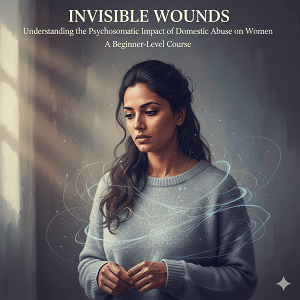
Have you ever wondered why survivors of domestic abuse often develop unexplained physical symptoms, chronic illness, or persistent pain long after the abuse has ended? Or why the body seems to remember trauma even when the mind tries to move on?

Welcome to Invisible Wounds: Psychosomatic Impact of Domestic Abuse, a warm, engaging, and academically grounded course that bridges neuroscience, psychology, and trauma-informed practice to help you understand one of the most misunderstood dimensions of abuse recovery.

This course explores the profound relationship between the mind and body in the context of domestic abuse. You will discover how repeated trauma rewires the nervous system, disrupts hormonal balance, alters brain structure, and manifests as real, measurable physical symptoms. We use plain language, relatable examples, helpful analogies, and evidence-based neuroscience to make complex concepts accessible and meaningful.

Whether you are a professional working with survivors, a student of psychology or social work, an educator, a coach, or someone on your own healing journey, this course meets you where you are and walks with you step by step.

Show More

What Will You Learn?

  • 1. Define psychosomatic illness and explain how it relates to domestic abuse trauma.
  • 2. Describe the structure and function of the brain regions most affected by chronic trauma (amygdala, hippocampus, prefrontal cortex).
  • 3. Explain the role of the autonomic nervous system and stress responses (fight, flight, freeze, fawn).
  • 4. Identify the most common physical symptoms and chronic conditions associated with domestic abuse.
  • 5. Understand the concept of allostatic load and how prolonged stress damages the body over time.
  • 6. Explain how childhood domestic abuse affects neurodevelopment and long-term health outcomes.
  • 7. Apply trauma-informed language and principles when discussing or supporting survivors.
  • 8. Identify evidence-based therapeutic and holistic approaches that address both psychological and physical trauma.
  • 9. Recognise how cultural, gender, and systemic factors influence psychosomatic symptom experience.
  • 10. Develop personal or professional tools for advocacy, support, or self-care in this context.

Course Content

MODULE 1: Understanding the Mind-Body Connection
Module Overview This foundational module introduces the concept of psychosomatic illness, challenges common myths, and sets the tone for the entire course with warmth, curiosity, and academic grounding. Before we can understand how domestic abuse affects the body, we need to understand the remarkable relationship between our thoughts, emotions, and physical health. Module Learning Objectives - by the end of this module, you will be able to: • Define the mind-body connection and explain why it matters in trauma contexts. • Define and differentiate psychosomatic illness from imaginary illness. • Describe the basic neurobiological pathways linking emotions to physical health. • Identify historical milestones in psychosomatic medicine. • Apply empathetic, non-stigmatising language to discussions of psychosomatic symptoms. Suggested Duration: 3 to 3.5 hours

  • LESSON 1.1: What Is the Mind-Body Connection?
  • LESSON 1.2: Psychosomatic Illness Explained
  • LESSON 1.3: Brief History of Psychosomatic Medicine
  • Activity 1.1: The Body Awareness Check-In
  • Activity 1.2: Myth Busting Discussion or Journal
  • Activity 1.3: Timeline Research Task
  • Activity 1.4: The Stress Response in Everyday Life
  • Questions 1

MODULE 2: The Brain Under Siege Neuroscience of Trauma
Module Overview This module explores the extraordinary neuroscience of trauma. We look at how the brain is structured, which regions are most affected by domestic abuse, how trauma literally changes the brain, and what this means for survivors. This is where science becomes deeply human. Module Learning Objectives: • Describe the key structures of the brain relevant to trauma (amygdala, hippocampus, prefrontal cortex, hypothalamus). • Explain how chronic trauma alters brain structure and function. • Define neuroplasticity and explain its relevance to healing from trauma. • Explain the concept of trauma-primed nervous systems. • Apply this knowledge to build understanding and empathy for survivor behaviour. Suggested Duration: 3.5 to 4 hours

MODULE 3: The Body Remembers Physical Symptoms of Trauma
Module Overview This module is where neuroscience meets lived experience most tangibly. We explore the specific physical symptoms and conditions that emerge in domestic abuse survivors as a result of chronic trauma. These are real, measurable, and often misunderstood symptoms that deserve our full clinical and compassionate attention. Module Learning Objectives: • Identify the most common physical symptoms associated with domestic abuse trauma. • Explain the neurobiological mechanisms behind each symptom category. • Define allostatic load and explain how it contributes to physical illness. • Describe the gut-brain axis and its relevance to trauma. • Recognise the importance of trauma-informed assessment in medical settings. Suggested Duration: 3 to 3.5 hours

MODULE 4: Trauma Across the Lifespan Developmental and Long-Term Effects
Module Overview Domestic abuse does not just harm the person being abused. It reshapes their development, alters their trajectories, and writes itself into their biology in ways that can last decades. This module explores how exposure to domestic abuse at different life stages affects neurological development, attachment, identity, and long-term health. Module Learning Objectives: • Explain how domestic abuse affects neurodevelopment in childhood and adolescence. • Describe the concept of attachment and explain how abuse disrupts attachment patterns. • Identify the long-term health and psychological consequences of childhood exposure to domestic abuse. • Explain how trauma can be transmitted across generations. • Apply a developmental lens to supporting survivors at different life stages. Suggested Duration: 3.5 to 4 hours

MODULE 5: Gender, Culture, and Systemic Dimensions
Module Overview Psychosomatic responses to domestic abuse do not occur in a vacuum. They are shaped by gender norms, cultural context, socioeconomic factors, and systemic structures that either protect or further harm survivors. This module broadens our lens to examine how these intersecting factors influence the experience, recognition, and treatment of trauma-related physical illness. Module Learning Objectives: • Explain how gender norms influence the experience and reporting of psychosomatic symptoms. • Describe how cultural context shapes the expression and interpretation of trauma. • Identify systemic barriers that prevent survivors from accessing appropriate care. • Apply an intersectional lens to trauma-informed practice. • Recognise the specific needs and vulnerabilities of marginalised populations. Suggested Duration: 3 to 3.5 hours

MODULE 6: Pathways to Healing Therapeutic and Holistic Approaches
Module Overview We have spent five modules understanding the wound. Now it is time to explore the healing. This final and hopeful module surveys the evidence-based therapeutic, somatic, relational, and holistic approaches that support recovery from domestic abuse and its psychosomatic effects. We hold the complexity of healing with honesty, acknowledging that it is rarely linear, always deeply personal, and remarkably possible. Module Learning Objectives: • Identify and describe evidence-based therapeutic approaches for trauma and psychosomatic symptoms. • Explain the rationale for body-based (somatic) approaches in trauma recovery. • Describe the role of social connection, community, and spirituality in healing. • Apply trauma-informed principles to practical support interactions. • Develop a personalised or professional healing framework for ongoing application. Suggested Duration: 3.5 to 4 hours

Earn a certificate

Add this certificate to your resume to demonstrate your skills & increase your chances of getting noticed.
selected template

Student Ratings & Reviews

No Review Yet
No Review Yet
Scroll to Top