
Are You a Slow Learner? Your Brain Might Be Doing Something Remarkable
Maybe a teacher said it. Maybe a parent. Maybe you just started believing it somewhere along the way, that you learn too slowly, that you can’t keep up, that everyone else gets it faster than you do.
That belief? It’s worth examining. Because what’s often labelled as slow learning is actually something quite different when you look at what’s happening inside the brain.
This post is for anyone who has ever been called a slow learner or felt like one. Because the science tells a very different story, and it might change how you see yourself entirely.
What Does ‘Slow Learner’ Actually Mean?
The term ‘slow learner’ is often used to describe someone who takes longer than average to grasp new concepts, follow instructions, or complete tasks in an academic setting. It’s not a clinical diagnosis; it’s usually a comparison. And comparisons are almost always made against a standard that wasn’t designed with every type of brain in mind.
There are also genuine learning differences that can affect speed, but even then, speed is only one part of how a brain learns.
Here’s the thing: speed of processing is just one variable in learning. And it’s not the most important one.
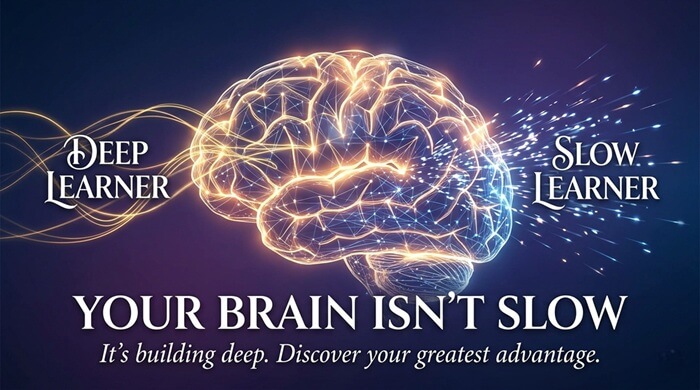
When we reduce learning ability to speed, we miss the bigger picture entirely. We miss depth. We miss connection-making. We miss the kind of understanding that actually sticks.
What Is Really Happening in a Slow Learner’s Brain?
When your brain encounters new information, it doesn’t just store it like a file in a cabinet. It has to connect that new information to what it already knows, building bridges between neurons in a process called elaborative encoding.
The richer and more complex those connections are, the more durable the memory becomes. This is well-established in neuroscience. It’s also why your most meaningful memories are so vivid; they’re wired into a whole network of associations, emotions, and context.
Now, here’s what tends to happen with people who process more slowly:
- They naturally pause longer on new information, giving the brain more time to form those connections
- They often branch out into related ideas or ask more questions, which creates a broader neural network around a concept
- They tend to sit with confusion rather than skipping past it, and working through confusion is how deep understanding is built.
In other words, what looks like slowness on the surface is often the brain doing more thorough work underneath.
The Problem with Being a ‘Fast’ Learner
Fast learners get a lot of praise. They finish first. They put their hands up first. They move through the curriculum without appearing to struggle.
But speed can mask a real problem: shallow encoding.
Some people can move quickly and build deep understanding, but many of us trade depth for speed when we’re under pressure.
When information is processed quickly and superficially, it’s stored in short-term memory, which means it fades fast. You might recall it for a test, but a few weeks later? Gone. This is sometimes called surface-level processing, and it’s linked to the forgetting curve, something your brain does naturally when information isn’t given time to consolidate.
Fast learners often have to revisit material multiple times because the first pass didn’t actually stick. Slow learners, on the other hand, often need fewer repetitions because they processed it more deeply the first time.
Neither approach is better in every situation. But it’s worth being honest that speed is not the same as comprehension.
Deep Learning vs Surface Learning: What Neuroscience Actually Shows
Neuroscience distinguishes between two broad types of learning:
Surface learning, where you memorise facts, follow steps, and reproduce information on demand. It’s fast, but it doesn’t transfer well to new situations.
Deep learning, where you build conceptual understanding, make connections to prior knowledge, and can apply what you’ve learned in different contexts. It takes longer, but it’s far more durable and flexible.
The brain regions involved in deep learning, particularly the hippocampus and prefrontal cortex, are doing significantly more work than in surface-level processing. They’re organising information, tagging it with meaning, and weaving it into your existing understanding of the world.
This kind of learning takes time. It requires reflection. It often involves sitting with uncertainty before clarity arrives.
If that sounds like what happens when you learn something, then ‘slow’ might not be the right word for you at all.
Signs You Might Be a Deep Learner (Not a Slow One)
Deep learners tend to share some recognisable patterns. See if any of these feel familiar:
- You want to understand why something works, not just how to do it
- You ask a lot of questions, sometimes questions that your classmates or colleagues don’t even think to ask
- You get distracted by interesting tangents while learning, and follow them
- You feel unsatisfied with a surface-level answer and keep digging
- Once you understand something, you really understand it, and you remember it for a long time
- You make connections between things that seem unrelated on the surface
- You feel slow in the moment, but later you can explain things more clearly than others.” That mirrors a very common experience.
None of these are signs of a problem. They’re signs of a brain that cares about meaning.
How to Work With Your Brain, Not Against It
If you are a slower, deeper processor, the worst thing you can do is try to force yourself into a speed that isn’t yours. That usually just creates anxiety, which, by the way, actively blocks learning by flooding the brain with cortisol and shutting down the prefrontal cortex. (More on that here: How Stress Affects Learning.)
Instead, here are a few things that actually work with a deep-processing brain:
Give yourself permission to pause
Pausing is not stalling. It’s your brain building neural connections. When you feel the urge to rush through something because everyone else has moved on, notice that urge and choose to stay with the material a little longer when you can.
Lean into your curiosity.
Those tangents you follow? They are not distractions. They’re your brain forming a richer web of understanding. Follow them. The broader your neural network around a concept, the better you’ll retain and apply it.
Use retrieval practice
Rather than re-reading your notes, test yourself on what you’ve learned. This is called active recall, and it’s one of the most evidence-backed learning strategies available. It works especially well for deep learners because it mirrors the way your brain already wants to process information. (Read more: What Is Active Recall and Why Does It Beat Highlighting Every Time?)
Stop comparing your pace to other people.
Their timeline is not your timeline. Your brain is not their brain. What matters is not how quickly you get there, it’s whether you actually get there, and whether the understanding lasts.
You Are Not Behind – You Are Different
The label ‘slow learner’ says almost nothing meaningful about intelligence. It says something about speed in a system that was largely designed to reward speed.
But outside that system, in real life and real careers and real relationships, depth of understanding matters enormously. The ability to think carefully, ask good questions, make unexpected connections, and truly comprehend something those are rare and valuable quality.
If you’ve carried the ‘slow learner’ label, it’s worth asking: slow compared to whom? And slow at what, exactly?
Because your brain is not broken, it’s not falling behind. It’s quite possibly doing something most people’s brains never take the time to do.
And that is something to be genuinely proud of.
If you’ve been called a slow learner, there’s a good chance you’re actually a deep learner, and the way your brain works is an advantage, not a flaw.
If this resonated with you, you might also like these posts on neurodiversity and how different brains learn:
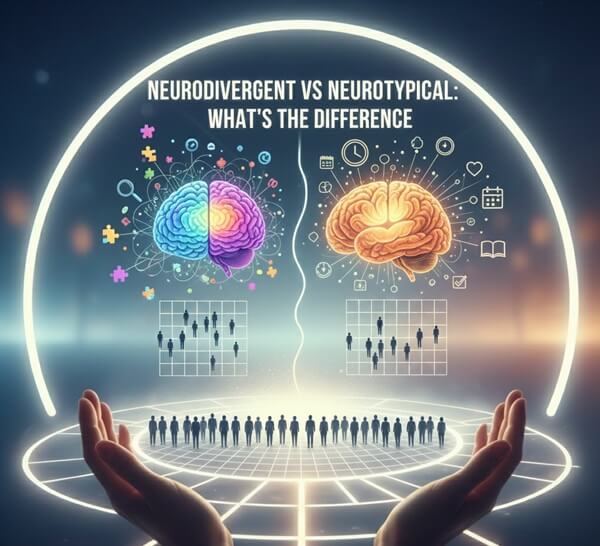
- Neurodivergent: What It Really Means (And Why It Matters), an introduction to neurodiversity
- How the Brain Learns: A Friendly Guide to What’s Happening in Your Head
- Why You Forget Everything You Study (and What to Do Instead)
- Your Brain never stopped being Able To Learn
You’ll find them all in the Neurodiversity & The Brain section of the blog.