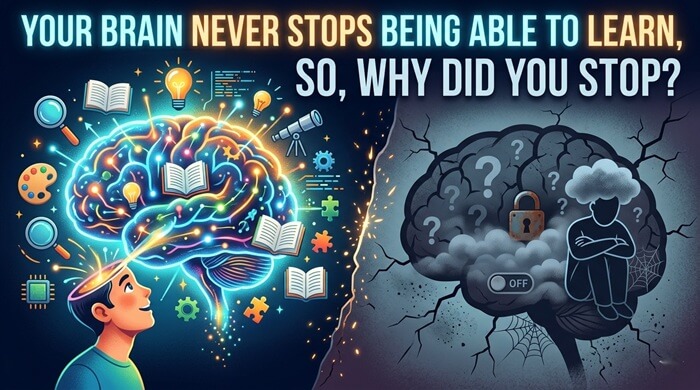
Your Brain Never Stops Being Able to Learn, So Why Did You Stop?
Let’s discover the benefits of lifelong learning
Think back to the last time you learned something genuinely new. Not scrolling through information. Not half-watching a tutorial in the background. Really learning something, a skill, a subject, a way of thinking that you didn’t have before.
For a lot of people, that memory takes a moment to locate. And when it surfaces, it’s often tied to formal education, a class, a course, something with a structure and a deadline and someone telling you it mattered.
Without that structure, learning quietly slips away. Life fills up. You tell yourself you’ll get to it. Months pass. And somewhere underneath the busyness, a quiet belief takes root: that learning is something you did, back then. Not something that’s still available to you now.
Here’s what neuroscience has to say about that belief: it’s wrong. And understanding why it’s wrong might be one of the most useful things you read today.
The Myth That the Brain Stops Changing
For a long time, the scientific consensus was that the brain reached a fixed state in early adulthood. You were dealt your hand of neurons, and that was it. Whatever learning happened in childhood and adolescence was largely what you had to work with.
That view has been comprehensively overturned.
We now know that the brain retains its neuroplasticity, its capacity to form new neural connections, strengthen existing pathways, and reorganise itself in response to experience, throughout the entire lifespan. The brains of a 50-year-old, a 65-year-old, and an 80-year-old are still capable of learning. Still capable of change. Still actively looking for it.
What does change with age is the conditions that support learning best. An older brain may need more repetition, more sleep, and more deliberate practice to consolidate new information. But the underlying capacity? That remains intact far longer than most people realise.
The brain doesn’t stop being ready to learn. We stop giving it the chance.
What Lifelong Learning Actually Does to Your Brain
The neuroscience here is genuinely compelling, and it goes well beyond simply ‘keeping the mind active.‘
It builds cognitive reserve
Cognitive reserve refers to the brain’s resilience, its capacity to cope with damage or decline without losing function. Think of it as a buffer. People who engage in regular learning throughout their lives tend to build a larger buffer, which means that even if the brain undergoes age-related changes, they have more capacity to absorb those changes before they affect how well they function.
Studies on lifelong learners consistently show greater cognitive reserve, later onset of cognitive decline, and better outcomes in the presence of neurological challenges. This isn’t about becoming a genius. It’s about keeping the brain robust enough to carry you well into old age.
It keeps neural pathways active and well-connected
Neural pathways work on a use-it-or-lose-it principle. When you regularly challenge your brain with new information, new skills, and new problems, you keep a wide network of pathways active and well-maintained. When learning stops, those pathways narrow. The brain becomes more efficient, yes, but efficiency here means it stops building new roads and starts relying on the old familiar routes.
Regular learning keeps the network wide. It gives the brain more routes to draw on when solving problems, adapting to change, or finding creative solutions.
It directly affects how you feel about yourself
This one is often underestimated. Learning something new, even something small, activates the brain’s reward circuitry. Dopamine is released when you make progress, when something clicks, when a skill starts to feel within reach. That reward signal matters. It builds motivation, reinforces curiosity, and creates a sense of genuine agency, the feeling that you are someone who can still grow.
For adults who have internalised the belief that they’re ‘not a learner,’ or who carry old wounds from school experiences that told them they weren’t good enough, this feels significant. Because the brain doesn’t require a classroom to experience that reward, it just requires the challenge.
Why Most Adults Stop Learning, and Why That’s Understandable
Before we talk about how to start again, it’s worth being honest about why learning stops in the first place. Because it usually isn’t laziness or indifference.
For many people, formal education was not a safe or affirming place. Learning became associated with judgment, comparison, and the threat of being seen as not intelligent enough. When that chapter closed, so did the association. Leaving it behind felt like relief.
For others, adult life simply didn’t leave room. The pressures of work, family, and survival crowded out the spaciousness that learning needs. And without someone telling you it was important, without grades or deadlines or a teacher expecting something of you, it was easy to let it slide indefinitely.
And for some, there’s a subtler barrier: the belief that the window has passed. That learning is for young people. That starting something new in your 40s, 50s, or 60s is somehow too late, or a little embarrassing, or bound to feel slow and difficult.
All of these are understandable. None of them is biologically true.
How to Start Again, In a Way That Actually Fits Your Life
The good news is that getting back into learning doesn’t require enrolling in a course, dedicating hours each week, or pursuing an ambition you don’t feel. The brain responds to consistency and challenge more than it responds to intensity.
Here are three approaches that work with adult life rather than against it.
Microlearning: small, regular, and genuinely useful
The brain consolidates learning through repetition over time, not through long, exhausting sessions. Short, focused bursts of learning, 10 to 20 minutes, done consistently, are genuinely more effective for retention than occasional marathon study sessions.
This means you don’t need a free afternoon. You need a recurring slot, a commute, a lunch break, and the 15 minutes before the day starts. The subject matters less than the consistency. Pick something that interests you, something that stretches you just slightly, and return to it regularly.
Learn alongside others
Humans are social learners. We process information more deeply in community, through discussion, debate, teaching others, and the gentle accountability of people who are curious alongside us. Isolation, on the other hand, tends to stall learning quickly.
This doesn’t have to be formal. A book club, an online community, a colleague who shares an interest, a friend you report back to. Social connection around learning doesn’t just make it more enjoyable; it activates additional neural encoding pathways that help information stick.
Follow genuine curiosity, not just usefulness
There is a tendency in adult learning to justify everything by its practicality. Will this skill help my career? Will this knowledge be useful? It’s a reasonable instinct; adults have limited time and real responsibilities.
But curiosity-driven learning is neurologically more powerful than obligation-driven learning. When you’re genuinely interested in something, the brain releases dopamine in anticipation, before you’ve even learned anything, which primes it to encode information more effectively. You learn faster, retain more, and keep coming back.
So, alongside the practical skills, give yourself permission to learn something simply because it fascinates you. Your brain will thank you for it in ways that show up far beyond that subject.
It’s Not Too Late, It Was Never Too Late
The story that learning belongs to the young, or to the formally educated, or to people with more time and more drive, that story is not supported by what we know about the brain.
Your brain is neuroplastic right now, today. It is looking for a challenge. It is ready to form new connections, build new capabilities, and update its understanding of what you’re capable of. The only thing standing between you and that process is the moment you decide to give it something to work with.
That moment doesn’t have to be dramatic. It can be a podcast on a topic you’ve always been curious about. A skill you quietly abandoned years ago. A question you’ve never properly followed to its answer.
Start there. Your brain and your future self will catch up.