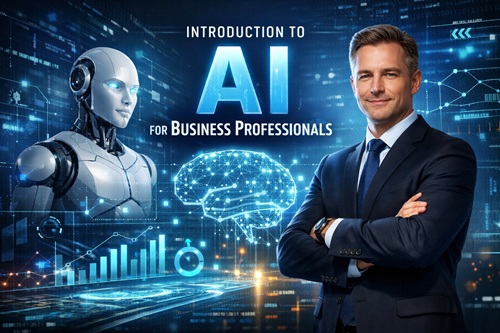
Intelligence For Business Professionals
About Course

Welcome to Introduction to AI for Business Professionals! Whether you have heard the term artificial intelligence a hundred times or you are completely new to it, this course was built with you in mind. We have designed every lesson to be warm, accessible, and genuinely useful, so you can walk away with real knowledge you can apply at work starting this week.

Artificial intelligence is no longer a distant concept from science fiction films. It is already reshaping how businesses operate, communicate, hire, sell, and make decisions. From the recommendation engine on your favourite shopping website to the chatbot answering customer queries at 2 am, AI is quietly running in the background of modern commerce. This course demystifies all of that.

Across three rich modules and nine carefully crafted lessons, you will learn what AI actually is (not just the hype), how the human brain inspired the machines, how AI is being used across industries right now, and how to think critically and ethically about the technology you will encounter in your career.

No mathematics degree is required. No coding experience is necessary. Just bring your curiosity and a willingness to think differently about the future of work.

If you find this course helpful, please consider leaving us a rating.

Show More

What Will You Learn?

  • • Explain what artificial intelligence is, including its history and core concepts, in plain language
  • • Describe how the human brain works and how neuroscience inspired the design of AI systems
  • • Identify the main types of AI (narrow AI, machine learning, deep learning) and explain the differences between them
  • • Recognise real-world applications of AI in sales, marketing, HR, finance, operations, and customer service
  • • Evaluate the ethical, legal, and social implications of AI in the workplace
  • • Develop an informed personal strategy for staying relevant as AI continues to evolve
  • • Apply practical thinking tools to assess whether an AI solution is right for a given business problem

Course Content

MODULE 1: UNDERSTANDING ARTIFICIAL INTELLIGENCE
Module Introduction Welcome to Module 1! This is where your AI journey begins, and we promise it is going to be more interesting than you might expect. Before businesses can use AI well, professionals need to understand what it actually is. Not the Hollywood version with robots taking over, and not the breathless hype you sometimes see in tech headlines. The real thing. In this module, you will trace the history of artificial intelligence from its surprising origins in the 1940s all the way to the large language models reshaping business today. You will learn the key vocabulary that will help you read an AI article and actually understand it. And you will explore how neuroscience, specifically the study of how brains learn, directly inspired the design of modern AI systems. By the time you finish Module 1, you will be able to walk into any boardroom conversation about AI and hold your own. Let us get started. Module 1 Learning Objectives • Define artificial intelligence and explain its key distinctions from traditional software • Summarise the major milestones in the history of AI development from 1950 to today • Describe the basic structure and function of the human brain's neurons • Explain how artificial neural networks are modelled on biological neural networks • Differentiate between narrow AI, machine learning, and deep learning • Use core AI vocabulary accurately in professional conversations

  • Lesson 1.1: What Is Artificial Intelligence?
  • Lesson 1.2: The Neuroscience Basics Behind AI
  • Lesson 1.3: Types of AI: From Narrow to Deep Learning
  • Activity 1. A: The AI Audit Walk
  • Activity 1. B: Build a Brain-AI Comparison Map
  • Question 1

MODULE 2: AI IN BUSINESS – REAL APPLICATIONS TODAY
Module Introduction Welcome to Module 2! This is where theory meets the real world, and where many learners find that their learning really accelerates. In Module 1, you built the conceptual and neurological foundations for understanding AI. Now we are going to walk through how AI is actually being used in business today, across the full range of functions, industries, and business sizes. We will look at customer experience and sales, where AI is already dramatically changing how companies interact with customers. We will explore operations and decision-making, where AI is helping organisations process data at a scale that would be impossible for human teams alone. And we will examine the workforce itself: how AI is changing the nature of work, what it means for jobs, and how professionals can position themselves for success in an AI-augmented workplace. Throughout this module, we will use real-world examples, case studies, and practical frameworks. The goal is not just to inform you but to equip you with the analytical vocabulary to evaluate AI claims confidently, spot genuine opportunity, and avoid the very real risks that come with poorly implemented AI. Module 2 Learning Objectives • Identify and describe at least five real-world business applications of AI across different functional areas • Explain how AI is being used in customer service, marketing, sales, HR, finance, and operations • Evaluate the potential benefits and risks of AI adoption in a given business context • Apply a simple framework for assessing whether an AI solution is appropriate for a specific business problem • Discuss how AI is changing the nature of work and what skills will remain distinctly human • Reflect critically on case studies of AI deployment, including both successes and failures

MODULE 3: ETHICS, STRATEGY, AND THE AI-READY PROFESSIONAL
Module Introduction Welcome to Module 3, the final chapter of your Introduction to AI journey. You have come a long way. You now understand what AI is, where it came from, how it learns, and how it is being deployed across industries. Now we turn to the questions that will define your professional practice as an AI-literate leader: Is this AI fair? Is this AI trustworthy? How do we govern it responsibly? And how do I, as a professional, build a career that thrives in an AI-shaped world? These are not abstract philosophical questions. They are live, urgent, and commercially significant. Organisations that get AI ethics wrong face regulatory penalties, brand damage, and loss of customer trust. Organisations that approach AI governance thoughtfully are building durable competitive advantages. And professionals who understand the ethical and strategic dimensions of AI are among the most valuable people any organisation can hire. Let us explore this territory together. Module 3 Learning Objectives • Define and explain the key ethical challenges in AI, including bias, fairness, transparency, and accountability • Describe the current regulatory landscape for AI in major jurisdictions • Apply a practical ethical framework to evaluate an AI deployment decision • Explain the concept of explainable AI and why it matters for business • Develop a personal AI strategy for continuing professional development • Articulate the business case for responsible AI governance

Student Ratings & Reviews

No Review Yet
No Review Yet
Scroll to Top