
Understanding and Managing Anxiety Disorders

About Course

Understanding and Managing Anxiety Disorders
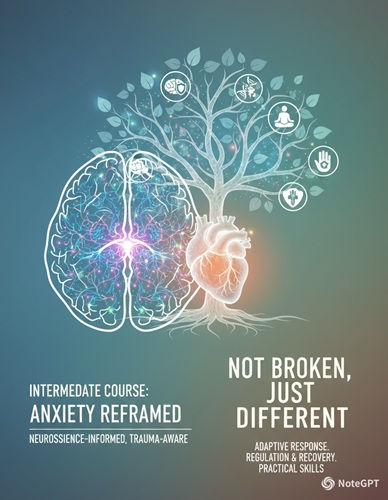
This intermediate-level course provides a comprehensive exploration of anxiety disorders through a neuroscience-informed, trauma-aware lens. Building on foundational knowledge of mental health, you will deepen your understanding of how anxiety manifests in the brain and body, learn evidence-based strategies for managing anxiety symptoms, and develop practical skills for supporting yourself or others experiencing anxiety.

Grounded in the philosophy that we are ‘not broken, just different,’ this course reframes anxiety as an adaptive nervous system response rather than a deficit. You will explore the neurobiological mechanisms underlying different anxiety disorders, examine how trauma and stress impact the anxiety response, and discover compassionate, science-based approaches to regulation and recovery.

Through engaging lessons, practical exercises, and real-world examples, you will gain both the theoretical knowledge and hands-on skills needed to understand and effectively manage anxiety in yourself or support others on their journey toward emotional well-being.

We’d love your feedback 

If this course supported your growth or sparked new insights, please take a moment to leave us a review on Google.

Your words help others find us, and help us keep creating meaningful, stigma-free learning experiences.

Leave a review here

Show More

What Will You Learn?

  • • Explain the neurobiological foundations of anxiety and how the nervous system generates anxiety responses
  • • Identify and differentiate between major anxiety disorders including Generalized Anxiety Disorder, Panic Disorder, Social Anxiety, Specific Phobias, and others
  • • Recognize how trauma, attachment, and early experiences shape anxiety patterns across the lifespan
  • • Apply evidence-based regulation techniques including somatic practices, cognitive strategies, and nervous system interventions
  • • Understand the role of medication, therapy modalities, and holistic approaches in anxiety management
  • • Create personalized anxiety management plans that honor individual neurobiology and lived experience
  • • Support others experiencing anxiety with trauma-informed, compassionate approaches
  • • Recognize when professional support is needed and how to access appropriate resources

Course Content

Module 1: The Neurobiology of Anxiety
Module Overview Welcome to the first module of Understanding and Managing Anxiety Disorders! In this module, we will explore the fascinating neurobiological foundations of anxiety. Rather than viewing anxiety as simply a mental or emotional problem, we will discover how anxiety is fundamentally a nervous system response - one that has evolved over millions of years to keep us safe. You will learn about the brain structures involved in anxiety, the role of neurotransmitters, and how your autonomic nervous system orchestrates the physical sensations you experience when anxious. This neuroscience-informed foundation will help you understand that anxiety is not a sign of weakness or brokenness, but rather an adaptive response that sometimes becomes overactive or misdirected. Learning Objectives By the end of this module, you will: • Explain the evolutionary purpose of anxiety and its role in human survival • Identify the key brain structures involved in anxiety responses, including the amygdala, hippocampus, and prefrontal cortex • Describe how neurotransmitters like serotonin, GABA, and norepinephrine influence anxiety levels • Understand the autonomic nervous system's role in creating physical anxiety symptoms • Recognize how the nervous system can become sensitized to threat over time

  • Lesson 1.1: Anxiety as an Adaptive Response
  • Lesson 1.2: Brain Structures and the Anxiety Circuit
  • Lesson 1.3: Neurotransmitters and the Autonomic Nervous System
  • Questions 1
  • Activity 1: Seven-Day Anxiety Tracking Journal
  • Activity 2: Brain Structure Mapping Exercise
  • Activity 3: Autonomic Nervous System State Awareness
  • Activity 4: Neurotransmitter and Lifestyle Connections
  • Activity 5: The Anxiety Spectrum Personal Mapping
  • Activity 6: Module Reflection and Personal Learning Synthesis

Module 2: Types of Anxiety Disorders
Module Overview In this module, we shift from the neurobiological foundations to exploring the different manifestations of anxiety disorders. While all anxiety disorders share common neurobiological mechanisms, they express themselves in unique ways - each with distinct symptoms, triggers, and patterns. Understanding these different presentations is crucial, whether you're working to manage your own anxiety or supporting others. We'll explore Generalized Anxiety Disorder, Panic Disorder, Social Anxiety Disorder, Specific Phobias, and other anxiety-related conditions. Throughout, we'll maintain our compassionate, neuroscience-informed perspective, recognizing that each disorder represents a particular pattern of nervous system activation, not a personal weakness or character flaw. Learning Objectives By the end of this module, you will: • Identify the key diagnostic criteria and symptoms for major anxiety disorders • Differentiate between different types of anxiety disorders based on their unique presentations • Understand how the same underlying neurobiology can manifest in various forms of anxiety • Recognize the impact of each anxiety disorder on daily functioning and quality of life • Apply diagnostic understanding to recognize when professional assessment may be needed

Module 3: Trauma, Attachment, and Anxiety
Module Overview In this module, we explore the profound connections between trauma, early attachment experiences, and anxiety patterns. Understanding these connections is crucial for compassionate, effective anxiety management. We'll examine how adverse experiences - both major traumatic events and chronic developmental stressors - shape our nervous systems and create lasting anxiety vulnerabilities. We'll also explore the hopeful reality of neuroplasticity and post-traumatic growth, recognizing that healing is possible even after significant trauma. Learning Objectives By the end of this module, you will: • Understand the difference between big T and little t trauma and their impacts on anxiety • Recognize how early attachment patterns influence adult anxiety responses • Identify the neurobiological changes that occur following trauma exposure • Explain the concept of complex trauma and its relationship to anxiety • Apply trauma-informed perspectives to understanding anxiety patterns

Module 4: Cognitive and Behavioral Approaches to Anxiety Management
Module Overview This module explores evidence-based cognitive and behavioral techniques for managing anxiety. You'll learn how thoughts, behaviors, and emotions interact to maintain or reduce anxiety. We'll cover cognitive restructuring, behavioral experiments, exposure therapy principles, and practical strategies for challenging anxiety-maintaining patterns. Learning Objectives • Understand the cognitive model of anxiety and thought-emotion-behavior connections • Apply cognitive restructuring techniques to challenge anxious thoughts • Implement behavioral activation and exposure principles • Create personalized cognitive-behavioral strategies for anxiety management • Recognize when to seek CBT from a trained professional

Module 5: Somatic and Nervous System Regulation Techniques
Module Overview This module explores body-based approaches to anxiety regulation. Building on our understanding of the autonomic nervous system, you'll learn practical techniques to directly influence your nervous system state, moving from sympathetic activation toward parasympathetic calm. We'll cover breathing techniques, progressive muscle relaxation, mindfulness practices, vagal nerve stimulation, and somatic experiencing approaches. Learning Objectives • Apply evidence-based breathing techniques for nervous system regulation • Practice progressive muscle relaxation and body scan meditations • Understand and stimulate vagal nerve activity for calming • Implement mindfulness practices for anxiety reduction • Create a personalized somatic regulation toolkit

Module 6: Treatment Approaches and Professional Support
Module Overview This module provides a comprehensive overview of professional treatment options for anxiety disorders. You'll learn about different types of therapy, medication options, when to seek professional help, how to find qualified providers, and what to expect from treatment. We'll explore both conventional and integrative approaches, always through a trauma-informed, neuroscience-based lens. Learning Objectives • Differentiate between major therapy modalities for anxiety (CBT, ACT, EMDR, somatic therapies) • Understand medication options for anxiety and how they work neurobiologically • Recognize when professional support is indicated vs. self-management approaches • Navigate the process of finding qualified mental health providers • Evaluate integrative and complementary approaches to anxiety treatment

Module 7: Building a Personalized Anxiety Management Plan
Module Overview This final module synthesizes everything you've learned throughout the course into a personalized, sustainable anxiety management plan. You'll assess your unique anxiety patterns, identify your most effective tools, create prevention and intervention strategies, build support systems, and develop plans for setbacks and long-term wellbeing. This module is practical and action-oriented, helping you translate knowledge into lasting change. Learning Objectives • Assess your individual anxiety patterns, triggers, and maintaining factors • Select evidence-based strategies that match your specific needs and preferences • Create a comprehensive anxiety management plan with prevention and intervention components • Develop sustainable self-care practices and support systems • Plan for setbacks and long-term maintenance of gains

Earn a certificate

Add this certificate to your resume to demonstrate your skills & increase your chances of getting noticed.
selected template

Student Ratings & Reviews

No Review Yet
No Review Yet
Scroll to Top