
How the Brain Learns: The Neuroscience Behind Real, Lasting Learning
If you’ve ever sat through a lecture, read the same paragraph four times, or crammed for an exam only to forget everything two days later, you’re not broken. You’re just working against how the brain learns, rather than with it.
That’s not a personal failure. It’s a design problem. Most of us were never taught how our brains actually take in, process, and hold onto new information. We were just expected to learn and blamed when we didn’t.
This post is your foundation. Think of it as the “why” behind everything else we explore on this blog. Once you understand the neuroscience of how the brain learns, every strategy, every tip, every shift in approach starts to make a lot more sense.
This is vital to understanding how the Brain Learns and how to learn effectively.
Let’s get into it.
What Learning Actually Is (At the Brain Level)
Learning science isn’t a passive process. It’s not information pouring into your brain like water into a cup. It’s something your brain actively builds.
At its most basic level, neuroscience of learning is the formation and strengthening of connections between neurons. The specialised cells in your brain that communicate through electrical and chemical signals. Every time you engage with something new, specific neurons fire together, creating or reinforcing a pathway.
There’s a well-known phrase in neuroscience: “Neurons that fire together, wire together.” The more often that pathway activates, the stronger and faster it becomes. Think of it like a trail through long grass. Walk it once, and it barely exists. Walk it a hundred times, and it becomes a clear path you can follow without thinking.
This process is called neuroplasticity, and it’s one of the most powerful things to understand about your brain. It means that learning genuinely changes your brain’s physical structure. Every time you learn something new, you’re literally rewiring yourself.
The Brain Structures Involved in Learning
Understanding how the brain learns also means knowing which parts of the brain are doing the heavy lifting. A few key regions are worth knowing about.
The Hippocampus: Your Memory Gateway
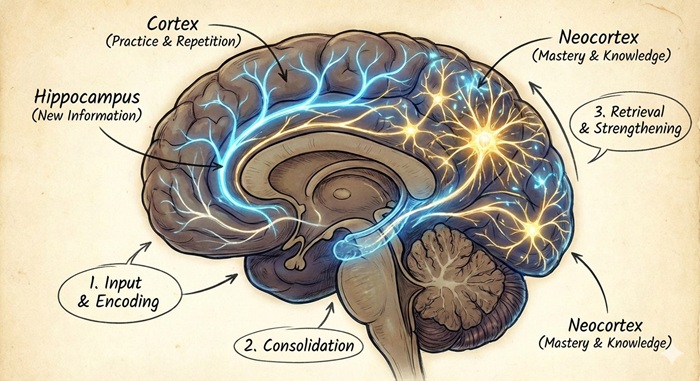
The hippocampus is a small, seahorse-shaped region deep in the brain, and it’s central to forming new memories. When you experience something, read something, hear something, or practise something, your hippocampus helps encode it by strengthening the connections between neurons that fired at the same time.
Here’s something important, though: the hippocampus is incredibly sensitive to stress. When your nervous system is in a threat state, the hippocampus essentially goes offline. This is why you can’t think clearly when you’re panicked, and why exam anxiety can cause you to blank on things you absolutely knew. Learning requires safety. We’ll come back to this.
The Prefrontal Cortex: Your Working Memory Centre
The prefrontal cortex. The large region at the front of your brain handles what’s called working memory. This is your brain’s mental workspace, where you hold and manipulate information in the short term. It’s what you’re using right now to read and make sense of this sentence. Working memory has a limited capacity, which is why trying to absorb too much at once often leads to nothing sticking. Effective learning works with this limit, not against it.
The Amygdala: The Emotional Filter
The amygdala processes emotional responses, particularly fear and threat. And it has a significant influence on what your brain decides to encode. Emotion isn’t separate from learning; it’s deeply woven into it. Things that feel meaningful, relevant, or emotionally charged are more likely to be remembered. Things that feel threatening or shameful trigger a protective response that actually shuts learning down.
The Cerebellum: Where Skill Becomes Automatic
When a skill becomes automatic, like typing without looking or riding a bike, it’s been transferred to the cerebellum. This is your brain’s efficiency engine. It takes tasks that once required conscious effort and runs them on autopilot, freeing up your prefrontal cortex for new learning. This is why practise and repetition matter so much: they’re the mechanism by which learning becomes skill.
How Memory Actually Forms – And Why Cramming Doesn’t Work
Memory isn’t stored like a file on a hard drive. It’s a distributed pattern of neural connections spread across multiple brain regions. And it’s not fixed; it’s reconstructed each time you recall it.
There are two key stages to how memories form:
- Encoding: This is the initial registration of new information. It happens when you engage actively with material, not just passively reading it, but processing it, connecting it to what you already know, or practising with it.
- Consolidation: This is when the memory gets stabilised and moved to long-term storage. Consolidation happens primarily during sleep, especially during deep sleep and REM stages. This is when your hippocampus replays the day’s learning and transfers it to the cortex for more permanent storage.
Cramming short-circuits both of these stages. You’re overloading your working memory without giving your brain time to consolidate. The information might stay just long enough for the exam, and then it’s gone, because it was never properly encoded in the first place.
This is exactly what we explore in depth in Why Traditional Learning Models Fail, and How to Learn Smarter, Not Harder. If you’ve ever felt like you were studying hard but getting nowhere, that post is worth your time.
The Role of Emotion in Learning
Here’s something most education systems completely ignore: emotion is not a distraction from learning. It’s a driver of it.
When something feels relevant, interesting, or meaningful to you, your brain releases dopamine, the neurotransmitter associated with reward and motivation. Dopamine signals to your hippocampus: “This matters, remember it.” This is why you can recall the lyrics of a song you haven’t heard in ten years but struggle to remember what you studied last week.
On the flip side, when learning is associated with shame, fear of failure, or threat (as it often is in traditional education), your amygdala triggers a stress response. Cortisol floods the system. The hippocampus goes quiet. And the very structure responsible for forming memories is suppressed, and this is why learning feels hard.
The reason why so many people who “struggled at school” aren’t those who can’t learn is that they are people whose nervous systems were in protection mode. Their brains weren’t given the safety they needed to do what they’re naturally built to do.
What the Brain Actually Needs to Learn Well
Now that you know how the brain learns at a structural level, let’s talk about what conditions it needs to do that well.
1. Safety
We’ve touched on this already, but it bears repeating: your brain cannot learn effectively while it’s in a threat state. Psychological safety (the feeling that it’s okay not to know, to make mistakes, to ask questions) is not a “nice to have.” It’s a neurological requirement. This applies to classrooms, workplaces, and the way you talk to yourself.
2. Active Engagement
Passive reading and listening create weak neural pathways. Active engagement, like questioning, applying, explaining back, and testing yourself, creates stronger ones. Every time you retrieve information from memory, you’re not just checking whether you know it. You’re strengthening the neural pathway that holds it. This is the science behind techniques like active recall and spaced repetition.
3. Spaced Practice
Your brain consolidates learning over time, not in a single session. Returning to material across multiple, spaced-out sessions dramatically improves long-term retention. This isn’t just study advice, it’s how the hippocampus builds durable pathways rather than temporary ones.
4. Emotional Relevance
Connect new information to something you already care about, something real in your life. When learning feels meaningful, your brain releases dopamine, which improves encoding and makes the experience more intrinsically motivating. You’re not just more likely to remember it, you’re more likely to keep going.
5. Rest and Sleep
Rest is not the absence of learning. It’s part of the process. During sleep, your brain consolidates new memories, clears metabolic waste, and restores the neurotransmitter levels you need to focus the next day. Consistently skipping sleep doesn’t just make you tired; it actively impairs the brain’s ability to form and retain memories.
Neuroplasticity: Why It’s Never Too Late to Learn Differently
One of the most important discoveries in modern neuroscience is that adult brains remain plastic. You can form new neural pathways, strengthen existing ones, and even grow new neurons in certain regions, at any age.
This matters enormously for people who internalised a story that they’re “not a learner,” “not academic,” or “just not that smart.” Those stories aren’t true. What’s true is that they were likely trying to learn in environments or using methods that weren’t built for their brains.
We go much deeper on this in How Neuroplasticity Can Rewire the Way You Learn – including practical ways you can start using neuroplasticity intentionally to build new learning habits.
The short version: change is possible. Your brain is not fixed. And the fact that you’re reading this is already evidence that some part of you knows that.
The Chemistry Behind Why Learning Feels Hard (Or Easy)
Your brain’s ability to learn isn’t just structural – it’s also chemical. Neurotransmitters regulate everything from how focused you feel to whether information makes it into long-term memory.
- Dopamine drives motivation and reward. When you’re curious or making progress, dopamine is flowing. When you’re bored or beaten down, it’s not.
- Norepinephrine regulates alertness and attention. Moderate levels sharpen focus; high levels (from acute stress) can narrow attention to the point of rigidity.
- Acetylcholine supports attention and memory formation. It’s particularly active during focused learning states and deep sleep consolidation.
- Cortisol is the stress hormone. In small doses, it sharpens alertness. In chronic excess, it damages the hippocampus, suppresses memory formation, and makes the brain prioritise survival over learning.
- GABA is your brain’s calming neurotransmitter. Adequate GABA function supports the calm, regulated state that’s most conducive to deep learning.
What This Means for You, Practically Speaking
Understanding how the brain learns doesn’t just satisfy intellectual curiosity. It changes how you approach your own growth.
When you know that stress shuts down the hippocampus, you understand why managing your nervous system isn’t a soft skill. It’s a prerequisite for learning. When you know that sleep consolidates memory, staying up late to study stops making sense. When you understand that emotion drives encoding, you stop trying to force yourself through dry material and start asking: how can I make this feel relevant?
None of this requires a perfect environment or a perfectly regulated nervous system. It just requires a different lens. One that puts your brain’s actual needs at the centre of how you approach learning.
That’s exactly what ShiftEd Minds is built around. Not harder work. Smarter, more brain-aligned work.
Where to Go From Here
This post is your foundation. The rest of our Learning Science & Education content goes deeper into specific pieces of this puzzle. Here’s what we’d recommend exploring next:
- Why Traditional Learning Models Fail, and How to Learn Smarter, Not Harder – understand why the system wasn’t built for your brain, and what to do instead.
- How Neuroplasticity Can Rewire the Way You Learn – the practical guide to using your brain’s adaptability to build new learning habits.
Learning is one of the most human things we do. And your brain is far more capable than anyone may have led you to believe. It just needs the right conditions.
That’s what we’re here to help you build.
Are you ready to explore further? The instruction manual for your brain is here.” You will discover why learning feels hard and how to learn effectively.