

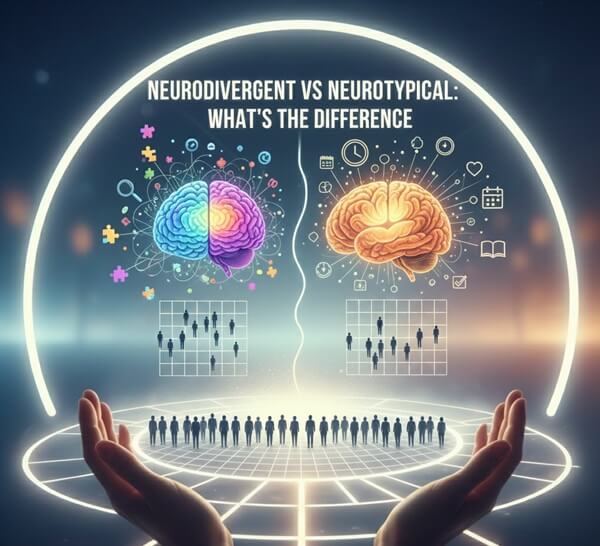
Neurodivergent vs Neurotypical: What’s the Difference (Without the Labels)
If you’ve been reading about neurodivergence, you’ve probably come across the term neurotypical as well. And with that often comes comparison.
Am I one or the other?
Is one better?
Does this explain why I’ve always felt out of step?
Before those questions spiral, let’s slow this down and look at what these terms actually mean – without turning them into boxes.
What Does “Neurotypical” Mean?
Neurotypical is not a compliment.
It’s not a gold standard.
And it doesn’t mean “normal” in the way people often assume.
Neurotypical simply refers to people whose brains tend to function in ways that align with the most common expectations of society, particularly around:
- Learning styles
- Attention and focus
- Emotional regulation
- Social communication
Because these patterns are more common, most systems are built around them – especially schools, workplaces, and productivity models.
That’s not because they’re superior.
It’s because they’re statistically typical.
What Does “Neurodivergent” Mean in Comparison?
Neurodivergent describes brains that diverge from those dominant patterns.
This divergence can show up in:
- How information is processed
- How attention moves
- How emotions are felt or expressed
- How learning happens
Again – different, not defective.
A useful way to think about this is not types of people, but types of nervous systems navigating the same environment.
When the environment matches the nervous system, things feel easier.
When it doesn’t, strain shows up.
That’s not failure.
That’s a mismatch.
The Real Issue Isn’t the Brain – It’s the System
Here’s the part that often gets missed.
Most modern systems are designed for:
- Sitting still for long periods
- Linear processing
- Delayed rewards
- Standardised pacing
If your brain works well that way, you’re unlikely to question it.
If it doesn’t, you may have grown up feeling:
- Distracted
- Too much
- Not enough
- Out of sync
Not because you lacked ability – but because the system wasn’t built with your processing style in mind.
Difficulty is often treated as a personal flaw when it’s actually feedback.
This Is Not a Hierarchy
It’s important to say this clearly:
Neurotypical and neurodivergent are not opposites.
They’re not competing identities.
And they’re not fixed categories.
Many people sit somewhere in between, or move between patterns depending on context, stress, or life stage.
These terms are meant to describe tendencies, not define worth.
Why Comparison Can Be Unhelpful
Once people encounter these terms, comparison tends to creep in:
- “They can do this so easily — why can’t I?”
- “Maybe I’m just not disciplined enough.”
- “Something must be wrong with me.”
That line of thinking is where shame grows.
A more useful question isn’t:
Which one am I?
It’s:
What conditions help me function at my best?
That shift changes everything.
A Gentle Pause for Reflection
You don’t need to answer these — just notice what comes up.
- When have I felt most capable, clear, or energised?
- In what environments do I struggle the most?
- Where have I mistaken mismatch for personal failure?
Awareness comes before change.
There’s no rush here.
Why This Understanding Matters
Understanding these differences isn’t about adopting a label.
It’s about:
- Reducing self-judgment
- Designing better learning and working conditions
- Letting go of one-size-fits-all expectations
When you stop measuring yourself against an average you were never meant to fit, you can finally ask better questions.
And better questions lead to better support.
Bringing It Back to the Bigger Picture
If this article raised more questions than answers, that’s okay.
Clarity often starts that way.
If you haven’t yet, you may want to read the pillar article:
“Neurodivergent: What It Really Means (And Why It Matters)”
It lays the foundation for understanding these ideas without pressure or diagnosis.
This isn’t about deciding who you are.
It’s about understanding how you work – and treating that with respect.
You don’t need to take action right now. Understanding is often the first step and sometimes the most important one.