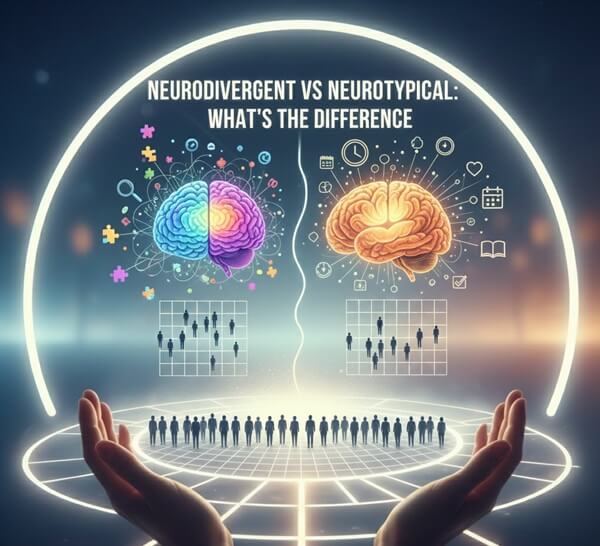


Neurodivergent: What It Really Means (And Why It Matters)
Understanding what does neurodivergent means, is the first step toward seeing your brain differently. If you’re anything like me, the first time you came across the term neurodivergent, you probably paused and thought:
- What does that even mean?
- Where does this term come from?
- Why am I hearing it everywhere now?
- Does this apply to me?
- And if it does… what does that say about me?
Those are normal questions. Important ones, actually.
Because language shapes how we see ourselves – especially when it comes to the brain.
So let’s slow this down and unpack it properly.
What Does Neurodivergent Mean?
Let’s start with the word itself.
“Neuro” refers to the brain and nervous system.
“Divergent” means different from the most common pattern.
That’s it.
Neurodivergent does not mean:
- Your brain is broken
- You chose to think this way
- You need to be “fixed.”
It means your brain processes information, emotion, learning, or attention differently from what society tends to label as “typical.”
Different — not wrong.
Where Does the Term Come From?
The concept of neurodiversity originated in the late 1990s, introduced by sociologist Judy Singer.
The idea was simple but powerful:
Human brains naturally vary – just like bodies, personalities, and talents.
What is relatively new is how widely the term is used.
In the last decade, especially, conversations around learning differences, attention, emotional regulation, and mental well-being have finally entered the mainstream.
So no – this isn’t a passing trend.
But it is a shift in how we talk about difference.
So, Why Does It Feel Like Labels Suddenly Changed Everything?
Here’s where things get nuanced.
Labels can be helpful or harmful – depending on how they’re used.
For some people, having language:
- Explains lifelong struggles
- Reduces self-blame
- Opens doors to support
For others, labels:
- Feel limiting
- Carry stigma
- They are used to dismiss or underestimate
The problem isn’t the word itself.
The problem is when labels replace understanding instead of supporting it.
Neurodivergent does not mean putting yourself in a box.
It’s a lens – one of many – to make sense of experience.
Does This Mean I Might Be Neurodivergent?
This is usually the quiet question people don’t say out loud.
Here’s the honest answer:
Learning about neurodivergence is not about diagnosing yourself.
It’s about noticing patterns and understanding the neurodivergent meaning
You might recognise things like:
- Learning best through doing, not sitting still
- Thinking faster than you can write or speak
- Struggling with focus but excelling under pressure
- Feeling emotions deeply
- Being sensitive to people, environments, or energy
Recognising yourself in these traits doesn’t define you.
It simply gives you information.
Information gives you a choice.
What Do I Do With This Information?
This is where many explanations stop – but it’s the part that matters most.
You don’t need to:
- Announce a label
- Justify yourself
- Apologise for how your mind works
What does help is this shift:
Stop asking “What’s wrong with me?”
Start asking “What works for me?”
When you understand how your brain prefers to learn, process, and respond, you can:
- Build strategies instead of forcing yourself into systems that drain you
- Work with your strengths instead of constantly correcting yourself
- Reduce shame, which is often the real obstacle to growth
What Does This Say About Me, Really?
This question sits underneath all the others.
So let me be very clear.
Being emotionally aware is not a flaw.
Being sensitive is not a weakness.
Thinking differently is not failure.
Sensitivity often means:
- You read rooms quickly
- You notice what others miss
- You feel nuance, not just facts
These traits can feel heavy in the wrong environment.
In the right one, they become sources of insight, creativity, and connection.
Neurodivergence doesn’t tell you who you are.
It helps explain how you experience the world.
And that understanding is something to work with – not something to fear.
A Final Thought
Now that you understand, what does neurodivergent mean
You don’t need to label yourself to respect how your mind works.
This conversation isn’t about fitting into a category.
It’s about replacing self-judgment with clarity.
Different brains need different approaches.
That’s not a problem – it’s reality.
And once you understand that, you stop trying to become someone else
and start learning how to support the person you already are.
You don’t need to take action right now. Understanding is often the first step – and sometimes the most crucial one.