
Why Traditional Education Fails Modern Brains (And What Works Instead)
The Problem Isn’t Learners – It’s the System
If traditional education worked, we wouldn’t see:
- Intelligent people who doubt themselves
- Adults are afraid to learn something new
- Chronic procrastination and burnout
- High effort with low retention
These are not motivation problems.
They’re design failures.
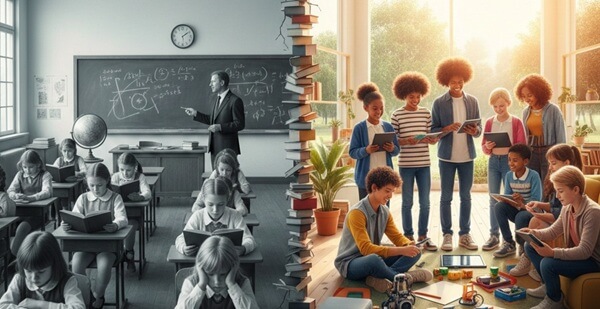
Traditional education was built for control and standardisation, not for how the human brain actually learns.
A System Designed for a Different Brain
Most education models still assume:
- Learning is linear
- Everyone learns at the same pace
- Information equals understanding
- Pressure improves performance
Neuroscience has disproven all of this.
The brain is adaptive, emotional, energy-conserving, and context-sensitive.
Traditional systems ignore these realities.
Where Traditional Education Breaks Down
1. It Overloads Attention
Long lectures, dense content, constant assessment.
This creates cognitive overload, which shuts down learning before it begins.
The brain doesn’t absorb more by being pushed harder — it disengages.
(See: Attention, Focus, and Cognitive Load: Why Your Brain Switches Off.)
2. It Punishes Mistakes
Mistakes are treated as failure instead of feedback.
The brain interprets this as a threat, activating survival responses that:
- Reduce working memory
- Inhibit recall
- Increase avoidance
Fear may produce compliance — but it kills curiosity.
3. It Ignores Emotion
Traditional education treats emotion as irrelevant or disruptive.
Neuroscience shows emotion determines:
- What gets stored
- What gets recalled
- What gets repeated
Without emotional engagement, learning becomes fragile and forgettable.
(See: Emotion, Motivation, and Learning: The Hidden Drivers of Memory.)
4. It Assumes Repetition Alone Creates Mastery
Rote repetition without meaning strengthens inefficient neural pathways.
Learning that lacks relevance or reflection:
- Feels exhausting
- Doesn’t transfer to real life
- Breaks under stress
The brain rewires through purposeful use, not passive repetition.
(See: Neuroplasticity Explained: How the Brain Rewires Through Learning.)
5. It Labels Difference as Deficit
Standardised systems struggle with:
- Neurodivergent learners
- Late bloomers
- Context-dependent thinkers
When learning environments don’t adapt, learners internalise failure — even when their brains are functioning exactly as designed.
What Neuroscience-Based Learning Does Differently
Neuroscience-aligned learning respects how the brain actually works.
It prioritises:
- Attention before information
- Safety before performance
- Meaning before memorisation
- Adaptation over standardisation
Learning becomes something people trust again.
The Shift That Changes Everything
Neuroscience-based learning asks different questions:
- Not “How do we push harder?”
- But “How do we reduce resistance?”
- Not “Why aren’t they motivated?”
- But “What’s blocking engagement?”
- Not “What’s wrong with the learner?”
- But “What’s mismatched in the environment?”
This shift alone transforms outcomes.
What Works Instead (In Practice)
Effective learning environments:
- Chunk information intentionally
- Allow reflection and integration
- Use feedback, not fear
- Support autonomy and identity
- Build habits gradually
Progress becomes sustainable instead of forced.
Why This Matters Beyond Education
This isn’t just about schools or courses.
It affects:
- Workplace training
- Career transitions
- Personal development
- Mental wellbeing
- Confidence and self-trust
Learning is how people adapt to change.
When learning fails, so does adaptability.
The Takeaway
Traditional education didn’t fail because learners weren’t capable.
It failed because it ignored the brain.
Neuroscience-based learning doesn’t lower standards — it removes unnecessary barriers.
And when learning works with biology instead of against it, progress stops being a struggle.