

Why You Forget Everything You Study (And What to Actually Do About It)
You spend hours reviewing notes. You re-read the textbook. Continuously pulling all-nighters. You highlight, you summarise, you make flashcards. And then, a week later, or sometimes just a day later, it’s like none of it ever happened. The information’s just gone. So, this is why you forget what you study?
If that sounds familiar, you’re not alone. And more importantly: you’re not broken. Forgetting is not a sign that you’re a bad learner. It’s actually how memory works. The problem isn’t that you forget. It’s that most of us were never taught how to work with the way our brains naturally encode and retain information.
Let’s talk about why you forget what you study. Why forgetting happens, what’s actually going on in your brain when it does, and – most importantly – what you can do about it. (If you haven’t already, it’s worth reading how the brain learns first, as this builds on those foundations.)
If you are wondering why you forget what you study, or think that you can’t study anymore, you are not alone.
The Forgetting Curve: Why Memory Fades So Fast
In the 1880s, German psychologist Hermann Ebbinghaus conducted one of the first scientific studies on memory. He tested his own ability to recall lists of nonsense syllables over time, and what he discovered has held up for over a century: we forget most of what we learn incredibly quickly.
Ebbinghaus found that without any reinforcement, people forget roughly 50% of newly learned information within the first hour. By the end of the first day, up to 70% is gone. Within a week, you’re left with only about 10% of what you originally took in.
This pattern, now called the forgetting curve, is consistent across most types of learning. And it explains exactly why cramming doesn’t work. You might retain just enough to scrape through an exam, but because the information was never properly encoded into long-term memory, it evaporates almost immediately afterward.
But here’s the important part: the forgetting curve isn’t inevitable. It can be flattened. And the way you do that is by understanding how memory consolidation actually works.
How Memory Actually Gets Stored (And Why Most Study Methods Don’t Help)
When you first encounter new information, it lands in your working memory, the brain’s temporary holding space, located primarily in the prefrontal cortex. Working memory is limited. It can only hold a few pieces of information at a time, and it fades fast unless something happens to move that information into long-term storage.
That “something” is called encoding, the process by which your hippocampus helps convert short-term memory into a more durable form. Encoding happens when you actively engage with the material: when you connect it to something you already know, when you practise retrieving it, or when you test yourself on it.
Here’s where most traditional study methods fall short. Passive activities, such as re-reading notes, highlighting, or listening to lectures, create weak encoding. Your brain processes the information, but it doesn’t flag it as something worth keeping. Without active retrieval or meaningful engagement, the neural pathway stays fragile, and the forgetting curve kicks in at full force.
This is one reason traditional learning models fail so consistently. They rely heavily on passive intake rather than active processing, which is exactly the opposite of what the brain needs to form durable memories, and the reason why you forget what you study.
What Actually Works: Evidence-Based Strategies for Retention
The good news is that once you understand why you forget what you study, you can use that understanding to build better learning habits. Here are the strategies backed by decades of cognitive science research.
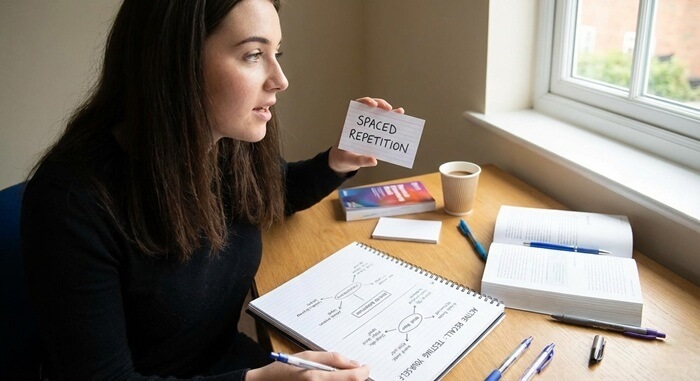
1. Spaced Repetition: The Most Powerful Retention Tool You Have
Spaced repetition means reviewing material at increasing intervals over time. Instead of cramming everything in one sitting, you revisit the information just as you’re about to forget it. This forces your brain to work harder to retrieve it, and that effort is what strengthens the memory.
A typical spaced repetition schedule might look like this:
- First review: 1 day after initial learning
- Second review: 3 days later
- Third review: 1 week later
- Fourth review: 2–4 weeks later
Each time you retrieve the information successfully, the neural pathway becomes stronger, and the interval before the next review can be longer. Spaced repetition doesn’t just help you remember, it fundamentally changes how your brain stores the information, moving it from fragile short-term encoding into stable long-term memory.
2. Active Recall: Stop Re-Reading, Start Retrieving
Active recall means testing yourself on the material without looking at your notes. Instead of passively reviewing what you’ve already written down, you force your brain to pull the information out of memory.
This feels harder than re-reading. That’s because it is. But that difficulty is exactly what makes it effective. Every time you successfully retrieve a memory, you strengthen the neural connections that hold it. Re-reading creates the illusion of learning. The material feels familiar, so you assume you know it. Retrieval practice reveals what you actually know.
Practical ways to use active recall:
- Close your notes and write down everything you remember
- Use flashcards (paper or apps like Anki)
- Teach the concept to someone else (or to yourself out loud)
- Practice past exam questions without looking at the answers first
3. Elaboration: Connect New Information to What You Already Know
Your brain remembers things better when they’re connected to existing knowledge. Elaboration means asking yourself questions like: How does this relate to something I already understand? Why does this matter? What’s an example from my own life?
When you create these connections, you’re not just memorising isolated facts; you’re weaving new information into a broader network of understanding. The more connections a memory has, the more retrieval paths your brain can use to access it later.
4. Sleep: The Brain’s Memory Consolidation System
Memory consolidation happens primarily during sleep. When you sleep – particularly during deep sleep and REM stages – your hippocampus replays the day’s learning, transferring information from temporary storage into the cortex for long-term retention.
Consistently skipping sleep doesn’t just make you tired. It directly impairs your brain’s ability to consolidate what you’ve studied. This is why all-nighters before exams are neuroscientifically counterproductive. You might cram more information in, but your brain won’t have the time it needs to actually store it. Sleep isn’t a luxury for learners. It’s a requirement.
5. Reduce Cognitive Load: Don’t Overload Your Working Memory
Your working memory can only hold a limited amount of information at once, typically around 4–7 items. If you try to learn too much in one session, you overwhelm the system. Nothing gets properly encoded, and the forgetting curve steepens.
Break material into smaller chunks. Focus on understanding one concept deeply before moving to the next. Give your brain time to process and consolidate before adding more. Quality of encoding beats quantity every time.
This is especially important if you’re learning under stress, as stress reduces your working memory capacity even further. Managing your nervous system isn’t a soft skill; it directly affects how much your brain can handle.
Why This Matters Beyond Studying for Exams
Understanding why you forget what you study (and what actually helps) is useful for more than just academic learning. It applies to any skill you’re trying to build, any knowledge you want to retain, and any area of life where growth matters to you.
If you’ve spent years internalising the story that you’re “bad at remembering things,” it’s worth revisiting that belief with this new information. The issue probably wasn’t your brain. It was the methods you were using. Methods that weren’t designed around how memory actually works.
Forgetting is normal. It’s how your brain filters out what doesn’t matter so it can focus on what does. The question isn’t how to stop forgetting. It’s how to make sure the things that matter to you make it through the filter.
Quick Summary: What to Do Differently Starting Today
If you’re ready to move away from passive re-reading and into strategies that actually work with your brain, here’s where to start:
- Test yourself instead of re-reading. Close the notes. Write down what you remember. Check what you missed.
- Review material in spaced intervals rather than all at once. Your brain consolidates better over time.
- Connect new information to what you already know. Ask: How does this relate to my life? Why does it matter?
- Prioritise sleep. Your brain literally needs it to move information into long-term storage.
- Break learning into smaller chunks. Don’t overload your working memory. Let one concept settle before adding the next.
You don’t forget because you’re not smart enough. You forget because that’s what brains do. The difference between people who retain information and people who don’t usually isn’t intelligence; it’s method.
Now you know the methods. The rest is just practice.