
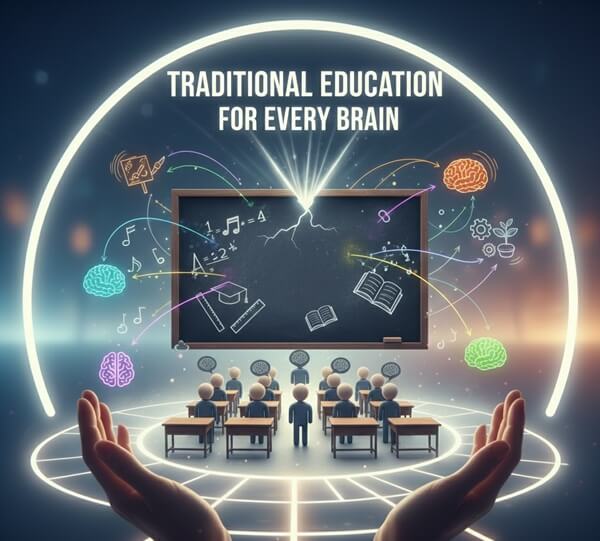
Why Traditional Education Doesn’t Work for Every Brain
For many people, school wasn’t just a place of learning.
It was where they quietly decided who they were.
“I’m not academic.”
“I struggle to focus.”
“I’m just not good at learning.”
Those conclusions often follow people well into adulthood – even when they’re capable, intelligent, and curious.
But here’s the truth that rarely gets said plainly:
Traditional education was never designed for every brain.
The One-Size-Fits-All Model
Most education systems were built around efficiency, standardisation, and scale. That led to learning environments that prioritise:
- Sitting still for long periods
- Listening more than doing
- Linear, step-by-step instruction
- One correct answer, one correct pace
- Performance under time pressure
For some brains, this works reasonably well.
For others, it creates constant friction.
Not because of lack of intelligence – but because the method and the mind don’t match.
When Learning Style Is Mistaken for Ability
Here’s where things often go wrong.
When a learner struggles in a rigid system, the struggle is frequently interpreted as:
- Lack of effort
- Poor discipline
- Low ability
Rarely is it framed as:
- A processing mismatch
- A nervous system under strain
- A need for a different approach
Over time, repeated mismatches become internalised.
The person doesn’t just struggle with the system —
They start to struggle with themselves.
Attention, Movement, and the Myth of Stillness
Traditional classrooms often expect sustained attention without movement.
But many brains regulate focus through movement, novelty, or interaction.
For these learners:
- Stillness can increase mental noise
- Passive listening can reduce retention
- Engagement improves when learning is active, visual, or applied
When those needs aren’t met, the learner isn’t “distracted.”
They’re under-stimulated or over-controlled.
That distinction matters.
Emotional Safety and the Ability to Learn
Learning is not just cognitive – it’s emotional.
When a learner feels:
- Constantly corrected
- Rushed
- Compared
- Or subtly shamed
The nervous system shifts into protection mode.
And a protected nervous system doesn’t learn efficiently.
It focuses on:
- Avoiding mistakes
- Not standing out
- Getting through the task
Not on curiosity, integration, or growth.
Intelligence Is Broader Than the Classroom Allows
Traditional education often rewards a narrow band of skills:
- Verbal recall
- Written expression
- Speed
- Memorisation
But intelligence also shows up as:
- Pattern recognition
- Big-picture thinking
- Creativity
- Emotional insight
- Practical problem-solving
Many people only discover how intelligent they are after they leave formal education – when the constraints loosen.
That’s not a coincidence.
What Happens When Learning Finally Fits
When learning aligns with how the brain works, something shifts.
People often describe:
- Relief
- Confidence returning
- A sense of capability they didn’t know they had
Not because they changed —
But because the environment did.
This is why adults who once struggled at school can thrive in hands-on work, entrepreneurship, creative fields, or self-directed learning.
The capacity was always there.
A Gentle Moment of Reflection
Again – no conclusions needed. Just notice.
- When did learning feel hardest for me, and why?
- Where did I learn best – even if it wasn’t in school?
- What beliefs about my intelligence might belong to the system, not to me?
Sometimes clarity comes from separating experience from identity.
This Isn’t About Blame
It’s important to say this clearly.
Teachers, parents, and institutions often worked within constraints they didn’t choose.
This isn’t about fault.
It’s about recognising that systems shape self-perception, and not every system fits every nervous system.
Understanding that can be deeply freeing.
Why This Understanding Matters Now
Many adults are trying to:
- Learn new skills
- Change careers
- Improve focus or motivation
- Rebuild confidence
And they’re doing it with outdated beliefs about their ability – beliefs formed in environments that never worked for them.
Once that context shifts, learning becomes less about forcing discipline
and more about designing support.
That’s when growth becomes sustainable.
Connecting Back to the Bigger Picture
If this resonates, it connects closely to the broader conversation about neurodivergence — not as a label, but as a way of understanding difference without judgment.
If you haven’t yet, you may want to read:
“Neurodivergent: What It Really Means (And Why It Matters)”
Not to define yourself –
But to reconsider the story you were told about how learning should look.
Different brains need different approaches.
That’s not a weakness.
That’s reality, and once acknowledged, it becomes a starting point rather than a barrier.
If you’d like to explore these patterns more gently, I sometimes share reflective tools and insights for people who want to understand how their brain works – without labels or pressure.