

Focus, Motivation, and the Myth of Laziness
Many adults find themselves wondering, “Why can’t I focus?”, even when they genuinely want to.
“Why can’t I just focus?”
“Why do I start strong and then fall off?”
“Why does it look so easy for others?”
These questions come with a quiet layer of self-judgment. Over time, that judgment often turns into a single, heavy conclusion:
I must be lazy.
But laziness is a poor explanation for patterns that repeat across a lifetime.
Research in psychology suggests that what we call laziness is often a sign of misalignment between our tasks and our brain’s reward system
So, Why Can’t I Focus? Here’s What’s Really Happening
If you’ve been asking why you can’t focus, the answer lies in your brain, not your character
What We Call Laziness Is Often a Mismatch
Laziness assumes a lack of care or effort.
In reality, many people who struggle with focus or motivation:
- Care deeply
- Try repeatedly
- Feel frustrated by their own inconsistency
What looks like avoidance is often a nervous system that:
- Struggles with sustained attention in low-stimulation environments
- Responds better to urgency, novelty, or meaning
- Shuts down under pressure or shame
That’s not laziness.
That’s a system working under the wrong conditions.
Focus Is Not a Moral Trait
Some people can sit for hours and concentrate linearly. Others can’t – but may hyperfocus intensely when interest or relevance is present.
Neither is superior.
Focus is influenced by:
- Interest and meaning
- Emotional state
- Environment
- Energy levels
- Psychological safety
When focus disappears, it’s often a signal, not a failure.
Motivation Follows Meaning, Not Discipline
One of the biggest myths in productivity culture is that motivation comes from discipline alone. Understanding “Why can’t I focus?” starts with looking at how the brain manages motivation
For many brains, motivation follows:
- Curiosity
- Relevance
- Emotional engagement
When a task feels meaningless or overwhelming, motivation drops – no matter how capable the person is.
This is why some people can:
- Work tirelessly on projects they care about
- Struggle to begin tasks that feel arbitrary or imposed
It’s not an inconsistency.
Its alignment.
The Role of Pressure and Deadlines
Pressure can be a double-edged sword.
For some, deadlines sharpen focus.
For others, they trigger anxiety or paralysis.
Many people rely on last-minute urgency to access focus — not because they enjoy stress, but because their nervous system activates under immediacy.
That strategy works… until it doesn’t.
Sustainable motivation requires more than pressure.
It requires understanding how your system engages.
Why Shame Makes Focus Worse
Shame is often used, subtly or directly, as a motivational tool.
But shame narrows attention, increases stress, and reduces cognitive flexibility.
When someone already struggles with focus, adding self-criticism:
- Depletes energy
- Increases avoidance
- Reinforces the very pattern they’re trying to change
Focus improves through support and clarity – not punishment.
Rethinking Productivity
Productivity isn’t about doing more.
It’s about doing what matters, in a way your system can sustain.
This might mean:
- Shorter work blocks
- Clearer priorities
- Visual or physical engagement
- Built-in recovery time
Working differently is not the same as working less seriously.
A Gentle Moment of Reflection
No fixing. Just noticing.
- When does my focus come most naturally?
- What kinds of tasks consistently drain me?
- What beliefs do I hold about my work habits — and where did they come from?
Awareness creates room for change without blame.
Responsibility Without Self-Punishment
Let’s be clear about something important.
Understanding your focus patterns is not an excuse to disengage from responsibility.
It’s a way to take responsibility more effectively.
When you stop fighting your nervous system, you can start designing strategies that actually work.
That’s not avoidance.
That’s maturity.
Bringing It Back to the Bigger Picture
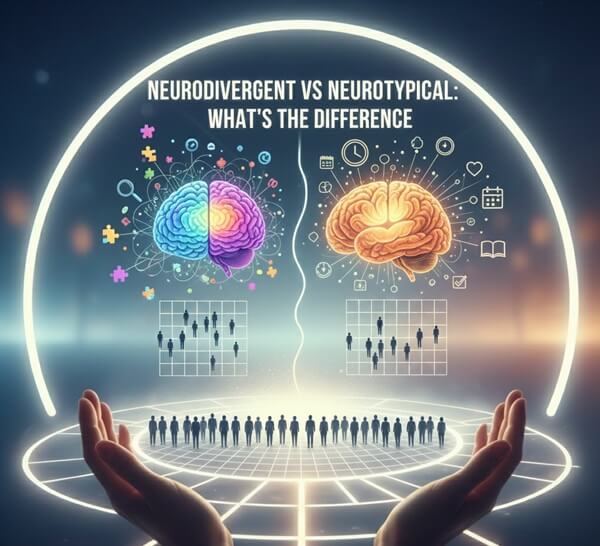
If this article resonates, it ties directly into the broader conversation around neurodivergence – not as a label, but as a framework for understanding difference, in understanding the “why can’t I focus.”
You may find it helpful to revisit:
“Neurodivergent: What It Really Means (And Why It Matters)”
Not to decide what you are –
But to understand how focus, motivation, and energy are shaped by the brain, not by character flaws.
You’re not lazy.
You’re likely misaligned – and alignment is something that can be built.
If you’d like to explore these patterns more gently, I sometimes share reflective tools and insights for people who want to understand how their brain works, without labels or pressure.