
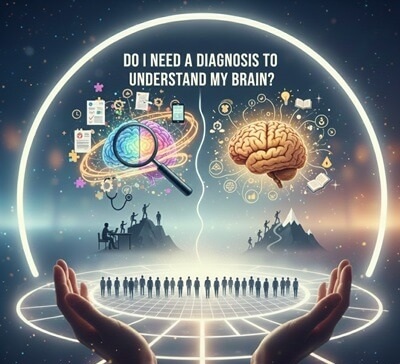
Do I Need a Diagnosis to Understand My Brain?
This is often the question people hesitate to ask out loud.
If I recognise myself in these patterns…
When these explanations resonate…
If things finally make sense…
Do I need a diagnosis to make this real?
It’s a fair question, and the answer is more nuanced than a simple yes or no.
What a Diagnosis Is – and What It Isn’t
A formal diagnosis is a medical or clinical process. It can be useful for:
- Accessing accommodations or support
- Understanding long-standing challenges
- Reducing confusion or self-blame
- Creating a shared language with professionals
But a diagnosis is not:
- A measure of intelligence
- A definition of identity
- Proof that your experience is valid
Your lived experience doesn’t begin at diagnosis – and it doesn’t require one to matter.
Why This Question Comes Up So Often
Many people seek a diagnosis because they want certainty.
They want to know:
- “Is this real, or am I imagining it?”
- “Do I finally have an explanation?”
- “Am I allowed to stop blaming myself?”
Underneath the question is often a deeper need:
Permission to understand themselves with compassion.
That permission doesn’t have to come from a label.
Understanding Without Labelling
Learning about how the brain works can be helpful without deciding what category you fit into.
You can notice:
- How your attention fluctuates
- What environments help or hinder learning
- How emotion affects focus and motivation
- What patterns repeat under stress
This kind of awareness leads to better self-support, regardless of diagnosis.
Insight is not reserved for those with paperwork.
When a Diagnosis Can Be Helpful
There are times when a formal diagnosis makes sense.
You might consider a professional assessment if:
- Challenges significantly interfere with daily life
- You need accommodations at work or in education
- You want structured clinical support
- You’ve reached a point where clarity would feel stabilising
Choosing an assessment is not a weakness.
It’s one possible form of support.
When It’s Okay Not to Pursue One
It’s also okay not to.
Many people:
- Gain enough clarity through learning and reflection
- Prefer focusing on strategies rather than labels
- Feel that understanding their nervous system is sufficient
There is no moral obligation to diagnose yourself, or to remain undiagnosed.
Both are valid choices.
The Risk of Over-Identification
One thing worth mentioning gently:
Labels can help explain experience – but they shouldn’t replace it.
When identity becomes too tightly wrapped around a diagnosis, people may:
- Limit themselves unintentionally
- Interpret every difficulty through a single lens
- Feel stuck in a story rather than supported by it
Understanding should expand possibilities, not shrink them.
A Gentle Pause for Reflection
No answers required – just awareness.
- What am I hoping a diagnosis would give me?
- What do I already understand about how my brain works?
- What kind of support would feel most helpful right now?
Clarity doesn’t always arrive all at once.
You Are Allowed to Understand Yourself
This matters.
You don’t need a diagnosis to:
- Respect your limits
- Design better learning or working conditions
- Use tools that support your focus
- Be compassionate with yourself
A diagnosis can be one form of clarity – but it is not the only one.
Bringing This Back to the Bigger Conversation
This question sits at the heart of the neurodivergence conversation.
If this article resonates, you may want to revisit:
“Neurodivergent: What It Really Means (And Why It Matters)”
Not to decide what label fits,
But to understand that human brains vary, and support should vary too.
Understanding your brain is not about permission.
It’s about curiosity, respect, and choice.
And those don’t require a diagnosis – only honesty.
Some people find it helpful to talk these things through with a neutral guide, not for diagnosis, but for clarity. If that’s something you’re curious about, you can read more about how we work here.
If you found this article helpful, we would appreciate your feedback. Please take a moment to give us a rating.