
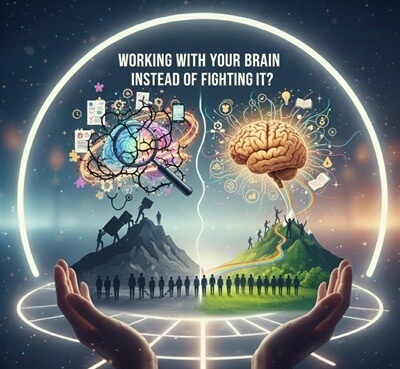
Working With Your Brain Instead of Fighting It
Many people spend years trying to fix themselves.
They push harder, set stricter rules, and tell themselves to be more disciplined – believing that if they just try enough, things will finally fall into place.
But effort isn’t always the issue.
Often, the real turning point comes when someone stops asking:
What’s wrong with me?
and starts asking:
How does my brain actually work – and how can I support it?
Why Fighting Yourself Is So Exhausting
When you constantly work against your natural patterns, daily life becomes heavy.
This can look like:
- Forcing focus in environments that drain you
- Ignoring emotional signals until burnout hits
- Copying productivity systems that never stick
- Believing rest must be earned
Over time, this creates a cycle of effort, frustration, and self-criticism.
Not because you’re incapable –
But because you’re misaligned.
Support Starts With Observation, Not Judgment
Working with your brain begins quietly.
It starts by noticing:
- When your energy rises and falls
- What kinds of tasks feel naturally engaging
- How stress affects your thinking
- Which environments help you feel clear
This isn’t self-analysis for the sake of control.
It’s curiosity without criticism.
You’re gathering information -not evidence against yourself.
Small Adjustments Make the Biggest Difference
Support doesn’t have to be dramatic to be effective.
Often, it looks like:
- Shorter work sessions with intentional breaks
- Visual or hands-on learning instead of passive reading
- Clear boundaries around emotional or sensory overload
- Choosing systems that flex rather than constrain
These changes may seem simple – but they reduce friction where it matters most.
Structure Can Be Kind
Structure often gets mistaken for restriction.
But the right kind of structure:
- Creates safety
- Reduces decision fatigue
- Supports consistency without pressure
This might mean:
- Gentle routines instead of rigid schedules
- Clear priorities instead of endless to-do lists
- External reminders instead of relying on memory
Structure isn’t about control – it’s about support.
Self-Compassion Is Not Self-Indulgence
Many people worry that being kind to themselves will make them complacent.
In reality, self-compassion increases:
- Motivation
- Persistence
- Willingness to try again
When mistakes are met with curiosity instead of punishment, learning accelerates.
That’s true for children – and it’s true for adults.
Designing Environments That Help You Thrive
Rather than forcing yourself to adapt endlessly, ask:
- What can I change around me?
- What drains me unnecessarily?
- Where can I reduce friction?
Working with your brain often means:
- Adjusting the environment
- Adjusting expectations
- Adjusting timelines
Not lowering standards – but making them sustainable.
A Gentle Moment of Reflection
There’s nothing to fix here. Just notice.
- Where am I fighting myself most?
- What has consistently helped me in the past?
- What would support look like if I stopped trying to be “normal”?
Small insights lead to meaningful shifts.
This Is a Practice, Not a Personality Trait
Working with your brain isn’t something you either do or don’t do.
It’s a practice – one that evolves as your life, stress levels, and responsibilities change.
There will be times you slip back into old patterns.
That doesn’t mean you’ve failed.
It means you’re human.
Bringing This Series to a Close
Throughout this cluster, we’ve explored:
- Difference without judgment
- Learning without shame
- Motivation without punishment
- Understanding without diagnosis
If you haven’t yet, you may want to return to the pillar article:
“Neurodivergent: What It Really Means (And Why It Matters)”
Not to define yourself –
But to remember that your brain isn’t something to battle.
It’s something to understand, support, and work alongside.
And when you do that, progress stops feeling like a fight
and starts feeling like a collaboration.
If you’re at a point where you’d like support working with your brain rather than against it, I offer one-on-one sessions focused on clarity, learning, and practical self-support. There’s no pressure – just an open door.