
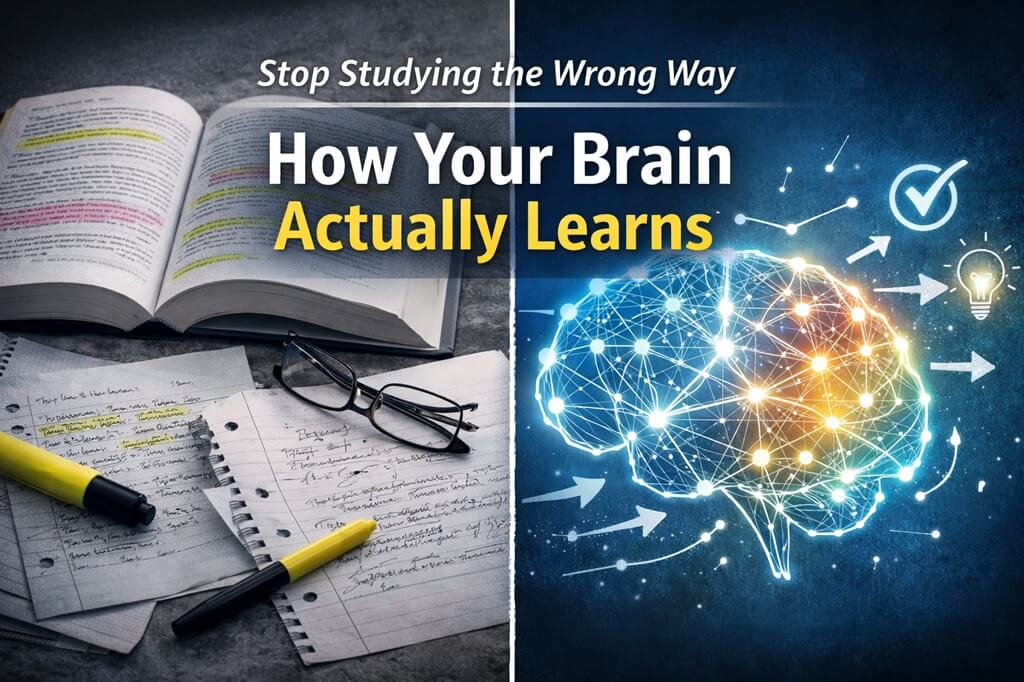
Why Everything You Were Taught About Learning Is Wrong, and What Neuroscience Reveals
Most people were never taught how learning actually works. The neuroscience of learning shows that many common study methods are fundamentally flawed…
Let’s start with something that might feel uncomfortably familiar.
You sit down to study something important. You read through your notes carefully. You highlight the key points. You read it again. It feels like it’s going in. You feel productive, like you’re doing the thing properly.
And then, a week later, you need that information. And it’s gone.
Not faded. Not fuzzy around the edges. Gone.
So you do what most people do in that moment. You conclude that your memory is terrible. That you’re just not a natural learner. That some people have it and some people don’t, and you, apparently, don’t.
Here’s what I want to say to you before we go any further.
That conclusion is wrong.
Not slightly wrong. Fundamentally, scientifically, demonstrably wrong.
What failed you wasn’t your memory. It wasn’t your intelligence. It wasn’t some fixed and limiting feature of who you are.
What failed you was the method. And the method was never based on how your brain actually works.
That’s what this post is about. The gap between how we were taught to learn and how learning actually happens, in every brain, at every age, in every subject. And what changes when you close that gap?
The Learning Lie We Were All Told
Most of us received our education in systems that were designed for a different era, built around the transmission of information from teacher to student, assessed through the reproduction of that information on demand.
The assumption underneath that system was simple: learning is about exposure. Hear it, read it, review it enough times, and it goes in. The more time you spend with the material, the more you’ll know.
That assumption felt reasonable. It was also wrong.
Not because the people who built those systems were careless or didn’t care about learners. But because the neuroscience of how memory actually works wasn’t well understood when those systems were designed. And by the time the research caught up, the systems were too entrenched to change quickly.
So we inherited methods that feel productive, highlighting, re-reading, and cramming, without inheriting the science that would have told us they don’t work as well as we think.
And when those methods failed us, we did what humans do. We blamed ourselves.
What Your Brain Actually Does With New Information
Here’s the version of memory nobody taught you in school.
Your brain is not a filing cabinet. It is not a hard drive. It does not store information in neat, retrievable folders. It is, and this is worth sitting with a living network of approximately 86 billion neurons, constantly forming new connections, constantly deciding what is worth keeping and what can be released.
When you encounter new information, your brain processes it in your working memory, the cognitive workspace where active thinking happens. Working memory is powerful. It is also small. It can hold a limited amount of information at once, which is why information overload feels so physically uncomfortable. Your brain isn’t struggling. It’s full.
For information to move from working memory into long-term memory, where it becomes yours, retrievable, and usable, it has to earn its place. It has to be processed meaningfully, connected to things you already know, and revisited over time in ways that signal to your brain: this matters, keep it.
This process is called memory consolidation. And it does not happen automatically just because you spent time with the material. It has to be earned, through the right kind of engagement, at the right intervals, in the right conditions.
Most of what we were taught about learning? It bypasses this process almost entirely.
The Myths – Named and Dismantled
Myth 1: Re-reading and highlighting are effective study strategies
They feel effective. That’s the problem.
When you re-read something you’ve already encountered, it feels familiar. Your brain interprets that familiarity as knowing. But familiarity and genuine recall are not the same cognitive process, and it’s recall that matters when you need to actually use what you’ve learned.
Psychologists call this the fluency illusion, the sense of knowing created by repeated exposure that doesn’t survive the moment the notes close and the real world asks the question.
Research comparing learners who re-read material with learners who test themselves after reading consistently finds the same result: the self-testers remember significantly more, not just immediately, but weeks later. The re-readers feel more confident. The self-testers actually know more.
Feeling like you know something and actually knowing it are not the same thing. And building a learning practice around the feeling rather than the reality is one of the most common and most costly mistakes a learner can make.
Myth 2: Cramming works
It works. In the short term. In the very specific conditions of an exam, the morning after the cram session.
And then it evaporates.
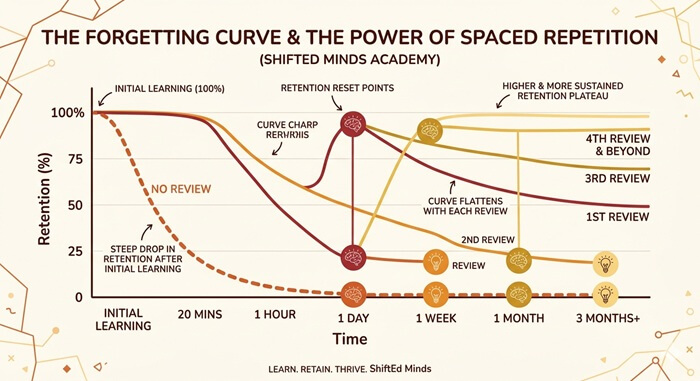
The reason cramming produces such poor long-term retention comes down to a concept called the forgetting curve, first mapped by psychologist Hermann Ebbinghaus in the 1880s and replicated consistently ever since.
We forget new information rapidly after first exposure. But, and this is the important part, each time we return to material after a gap, the rate of forgetting slows. Space your reviews strategically, and the information eventually becomes durable enough that very little maintenance is needed to keep it.
Cramming concentrates all the exposure into one session, with no gaps, no retrieval, no consolidation. It loads information into working memory and sends it to a short-term holding space. Without the spaced returns that signal this is worth keeping, the brain doesn’t consolidate it into long-term storage.
The information was there. It just wasn’t kept.
Myth 3: You have a learning style – and you should stick to it
This one is so widely believed, so deeply embedded in education culture, that dismantling it feels almost rude.
The VARK model – Visual, Auditory, Reading/Writing, Kinaesthetic – has been taught in schools and workplaces around the world for decades. The idea is intuitive: people are different, people learn differently, so identify each person’s style and teach them accordingly.
Except that when researchers went looking for evidence that matching teaching to learning styles produces better outcomes, they couldn’t find it. Not limited to evidence. Not mixed results. Decades of research have consistently failed to support the core claim.
Preferences are real. Some people genuinely enjoy diagrams. Some people love discussion. But the research makes clear that all learners benefit from engaging with material through multiple formats, not because it suits their style, but because multiple modes of engagement build multiple neural pathways to the same understanding.
The learner who reads about a concept, then sees it represented visually, then discusses it, then applies it, builds richer, more flexible, more durable knowledge than the learner who engages through their preferred mode alone.
The learning styles model didn’t just fail to help learners. In many cases, it limited them, creating a belief that certain modes of engagement weren’t for them before they’d genuinely given their brain a chance to work with them.
Myth 4: Struggle means something is wrong
This might be the most damaging myth of all, because it’s the one that turns temporary difficulty into permanent self-doubt.
When learning feels hard, when information doesn’t click immediately, when understanding takes time, when you have to work to make sense of something, the conclusion most people draw is that they’re not capable. That other people get it faster. That they’re somehow not built for this.
Here’s what neuroscience actually says about struggle.
Learning that requires genuine cognitive effort, that sits at the edge of your current understanding and asks your brain to stretch, produces stronger, more durable, more transferable memories than learning that comes easily. The difficulty is not a bug. It is the mechanism.
Psychologists call this desirable difficulty the finding that manageable challenge during learning, despite feeling less productive in the moment, consistently produces better long-term outcomes than frictionless, effortless engagement with material that’s already familiar.
Your brain doesn’t strengthen connections that don’t need strengthening. It is the act of reaching for understanding, the cognitive effort of making sense of something that isn’t immediately obvious, that triggers the neural work that makes learning stick.
Struggle is not a sign that you’re failing. It is a sign that your brain is working.
Why Most Learning Fails
Most people try to put information in
instead of training their brains to get it back out.
What Actually Works – The Science
So if re-reading, cramming, learning styles, and effortless engagement are all less effective than we thought, what does work?
The research is remarkably consistent. Three strategies appear in almost every serious review of learning science as among the most powerful tools available.
Retrieval Practice
Instead of reviewing material passively, reading it, watching it, and listening to it, retrieval practice asks you to actively recall it from memory.
Close the book. Write down everything you remember. Test yourself before you feel ready. Try to explain the concept without looking at your notes.
The act of reaching for information, even when it’s effortful, even when you get it partly wrong, strengthens the neural pathway associated with that memory more powerfully than any amount of passive review. This is known as the testing effect, and it has been replicated across subjects, ages, and contexts consistently for decades.
The discomfort of not immediately remembering something? That’s not failure. That’s the strategy working.
Spaced Repetition
Return to material at increasing intervals over time rather than concentrating all your study into a single session.
Study something today. Briefly revisit it in two days. Return to it again after a week. Review it once more a fortnight later. Each return requires slightly more retrieval effort than the last, and that effort is what signals to your brain that this information is worth consolidating into long-term storage.
Same material. Dramatically better retention. Simply through the strategic use of time.
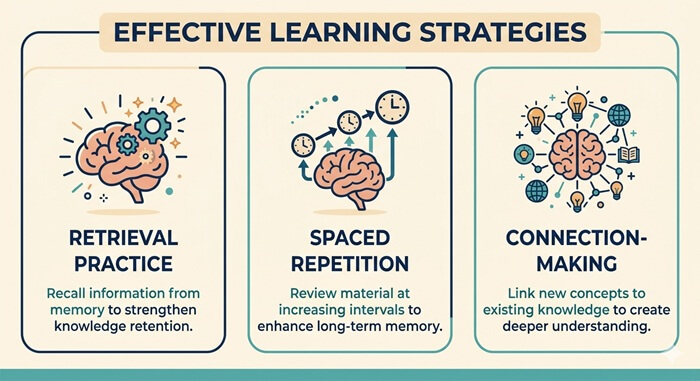
Connection-Making
Your brain learns new things by connecting them to things it already knows. Prior knowledge acts as scaffolding; the more you can connect new information to existing understanding, the more readily your brain can process, store, and later retrieve it.
This means that the simple habit of asking “what does this remind me of? Where have I seen this before? How does this connect to what I already know?” is not just a comprehension strategy. It is a neurological strategy, actively helping your brain find somewhere to put new information that will make it retrievable later.
The Part Nobody Talks About – Conditions Matter
Here’s something that surprises most people when they first encounter it.
Learning is not just about what you do with material. It is about the conditions in which you engage with it.
Chronic stress impairs the hippocampus, the brain region most responsible for forming new memories. High cortisol, released during significant stress, literally reduces the brain’s capacity to consolidate learning. Trying to study during a genuinely stressful period is not just unpleasant. It is neurologically inefficient.
Sleep is when memory consolidation happens. The brain replays and reinforces what was learned during the day while you sleep, a process that cannot be fully replicated by any other means. Cutting sleep short to study more is not a trade-off. It is a net loss.
Chronic multitasking, the constant switching between tasks that digital environments encourage, doesn’t just reduce productivity. It gradually degrades the capacity for the sustained, focused attention that deep learning requires. A brain trained to expect constant input becomes increasingly resistant to the low-stimulation, high-focus state that genuine learning demands.
And emotional safety matters more than most educational contexts acknowledge. When a learner feels judged, threatened, or at risk of being visibly wrong in front of others, the brain’s threat-detection system activates. And a brain in threat response is not, neurologically, in a position to engage in the higher-order thinking that deep learning requires.
Getting these conditions right is not the soft work that surrounds the real learning. It is the neurological foundation that determines whether real learning can happen at all.
This Applies to Every Brain – Including Yours
Here’s the thing about everything we’ve covered in this post.
None of it is specific to struggling learners. None of it is a special accommodation for people who find learning difficult. None of it is a compensation strategy for those whose brains work differently.
These are simply accurate descriptions of how human learning functions. In every neurological profile. At every age. In every subject.
The neurodivergent learner who thrives with explicit structure, psychological safety, multimodal engagement, and retrieval practice is not thriving because of a special intervention. They are thriving because those conditions genuinely optimise learning for human brains, and their brain, like every brain, responds accordingly.
The uncomfortable truth is that conventional education was never optimal for neurotypical learners either. It was simply less obviously harmful for those whose neurological profiles happened to align most closely with its assumptions.
What neuroscience offers is not a better education for some learners.
It is a better education. For every brain. Because it is built on how every brain actually works.
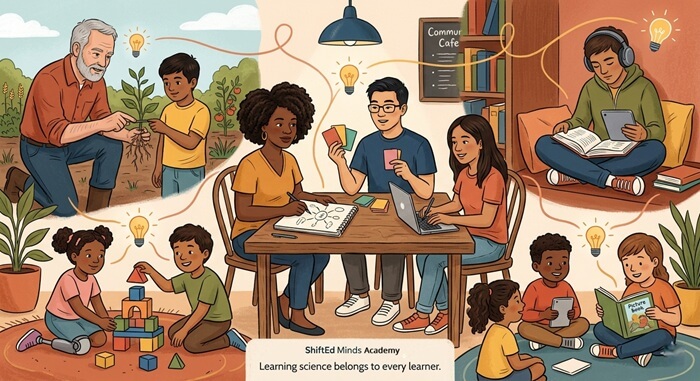
So What Do You Do With This?
If you’ve made it this far, and you’re sitting with the realisation that the methods you’ve been using haven’t been serving you as well as they could, here’s what I want you to know.
This is not about starting over. It is not about concluding that everything you’ve done until now was wasted. Learning, even inefficiently learned, is nothing. The understanding you’ve built is real.
It’s about what comes next. About approaching the next thing you want to learn, the skill, the subject, the domain, with a different set of tools. Tools built on what your brain actually needs rather than what feels productive in the moment.
Retrieval over re-reading. Spaced returns over single sessions. Connection-making over isolated memorisation. Managed conditions over grinding through regardless of state.
Small shifts. Real results.
And underneath all of it, the single most important shift of all.
Understanding that the struggle you’ve experienced as a learner was never evidence of your limitations. It was evidence of a mismatch between how you were taught and how your brain actually works.
That mismatch is fixable. Starting now.
The Framework Behind What Actually Works
If everything we’ve just covered feels like a lot, it can be simplified.
Not reduced. Just clarified.
Because when you strip away the noise, effective learning comes down to a small number of principles your brain responds to every single time.
Think of this as the structure underneath everything you’ve just read.
The 4 Principles Your Brain Actually Learns From
Retrieve
Stop reviewing.
Start pulling from memory.
Space
Come back to it.
Then come back again.
Mix
Don’t stay in one lane.
Force your brain to choose.
State
Sleep, stress, focus.
Your brain needs the right conditions.
1. Effort That Builds Memory (Active Recall)
Most people avoid the exact moment that actually creates learning.
The pause. The blank. The “I should know this, but I don’t.”
That moment isn’t failure. It’s the work.
When you stop looking at the material and try to bring it back yourself, when you explain it, write it out, or test yourself, you’re not just checking what you know. You’re strengthening it.
The harder it is to retrieve (within reason), the more your brain locks it in.
Shift the habit:
Don’t just go over information. Close it. Then try to pull it back.
2. Timing That Signals Importance (Spaced Repetition)
Your brain is constantly deciding what’s worth keeping.
If something shows up once and disappears, it gets treated like noise.
If it keeps coming back, especially after a bit of time has passed, your brain starts to pay attention.
That’s how memory becomes durable.
Not through intensity, but through timing.
Shift the habit:
Stop trying to “cover everything” in one sitting.
Come back to it. Then come back again, just as it starts to fade.
3. Mixing That Builds Flexibility (Interleaving)
Focusing on one thing for hours feels productive.
It isn’t always.
When you stay in one lane too long, your brain stops choosing. It just repeats. And repetition, on its own, doesn’t build understanding; it builds familiarity.
Mixing topics forces your brain to adjust. To recognise what it’s looking at. To decide what to do next.
That’s where real learning starts to show up.
Shift the habit:
Instead of mastering one thing in isolation, rotate between related ideas or skills.
4. The State Your Brain Is In (Biology Matters)
You can use every “right” strategy and still struggle if your brain isn’t in a position to learn.
Sleep isn’t optional here. It’s where learning is stabilised.
Stress, especially chronic stress, gets in the way of forming new memories.
And constant distraction trains your brain away from the kind of focus learning requires.
This isn’t separate from learning. It’s part of it.
Shift the habit:
Protect the conditions that allow your brain to do its job.
If You Put It All Together
When learning actually works, it tends to look like this:
- You try to retrieve, not just review
- You return over time, instead of cramming
- You mix and apply, instead of repeating
- You support the system, instead of pushing through exhaustion
It’s not more complicated than that.
It’s just different from what most of us were taught.
Why This Matters
None of this is about doing more.
It’s about doing what your brain already responds to, on purpose.
Because once you understand that, learning stops feeling like something you’re fighting…
…and starts becoming something you can actually direct.
Ready to Go Deeper?
This post is the beginning of a conversation that the Wired to Shift pathway at ShiftEd Minds was built to continue.
Three courses. From the foundational neuroscience of why learning feels hard, through the strategies and systems of an intermediate learner, all the way to the expert track for coaches and educators who want to create these conditions for others.
Built on genuine learning science. Written in plain language. Designed for every brain.
Because understanding how your mind works shouldn’t be reserved for researchers and academics. It should be available to every person who has ever sat down to learn something and wondered why it wasn’t working.
Your brain is not your enemy. It just needed a better instruction manual.
ShiftEd Minds creates neuroscience-based learning experiences for individuals, coaches, and educators. Our courses are built on the belief that every brain, neurotypical and neurodivergent alike, deserves education designed for how minds actually work.
Explore our full library of courses on learning science, neurodivergence, ADHD, autism, emotional regulation, mental health, and self-improvement.
Welcome to ShiftEd Minds. You were always capable of this. Now you know why. 🧠
Common Questions About How Learning Works
Q1: Why is re-reading not an effective study method?
Re-reading creates familiarity, not recall. The brain mistakes recognition for understanding, which doesn’t hold up when you need to retrieve the information later.
Q2: What is the most effective way to learn?
Active recall combined with spaced repetition consistently produces the strongest long-term retention.
Q3: How long should I study for the best results?
Short, repeated sessions spaced over time outperform long, single study sessions.
Q4: Does everyone learn the same way?
While preferences differ, the underlying mechanisms of learning are the same across all brains.
Q5: Why does learning feel difficult?
Because effective learning requires effort, that difficulty is part of the process that strengthens memory.