
Mind or Muscle? Heart vs. Panic Attacks in Men
About Course
Mind or Muscle? Heart vs. Panic Attacks in Men
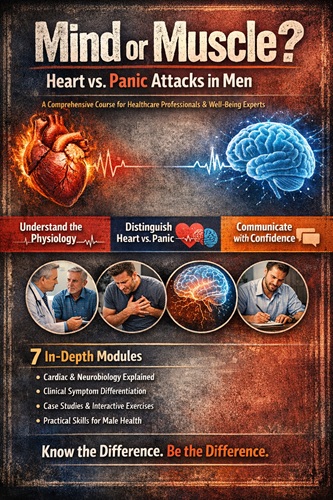
Have you ever wondered whether that racing heart and crushing chest tightness is your heart crying out for help or your nervous system stuck in overdrive? You are not alone. Every year, thousands of men in emergency rooms worldwide sit in the exact same uncertainty. This intermediate-level course cuts through the confusion with warmth, rigour, and real-world clarity.
Mind or Muscle? Heart vs. Panic Attacks in Men is a richly detailed, neuroscience-informed training resource designed for healthcare professionals, allied health workers, mental health practitioners, fitness coaches, and curious, health-conscious men. Over seven comprehensive modules, you will explore the cardiovascular and neurobiological underpinnings of both conditions, master clinical symptom differentiation, navigate diagnostic algorithms, and develop compassionate communication skills tailored to male health presentations.
The course blends academic rigour with accessible language, real-life case vignettes, engaging activities, and reflection prompts. Whether you sit at the bedside, behind a coaching desk, or at your own kitchen table wanting to understand your body better, this course meets you where you are and takes you somewhere genuinely valuable.
By the end of this course, you will not only know the difference between a heart attack and a panic attack, but you will understand WHY the difference exists at every level: from the cellular physiology of the myocardium to the firing patterns in the limbic system. That understanding will make you a better clinician, a better coach, a better advocate, and a healthier man.
.
Course Content
MODULE 1: Cardiovascular Physiology and the Stress Response
-
Lesson 1.1: The Heart as an Electromechanical Pump
-
Lesson 1.2: The Neurobiology of Stress and the Autonomic Nervous System
-
Lesson 1.3: From Stress Response to Pathology – Bridging the Two Conditions
-
Module 1 Summary: Key Takeaways
-
Questions 1
-
Activity 1: Your Stress Response Log
-
Activity 2: Coronary Artery Mapping
MODULE 2: Symptom Comparison and Clinical Presentation
MODULE 3: Neurobiological Mechanisms of Panic and Cardiac Events
MODULE 4: Diagnostic Evaluation and Treatment Pathways
MODULE 5: Comorbidities, Risk Factors, and Diagnostic Complexity
MODULE 6: Communication Strategies and Male-Centred Care
MODULE 7: Case Studies, Integration, and Real-World Application
Earn a certificate
Add this certificate to your resume to demonstrate your skills & increase your chances of getting noticed.
Student Ratings & Reviews