
Mind or Muscle? Heart vs. Panic Attacks in Men

About Course

Mind or Muscle? Heart vs. Panic Attacks in Men
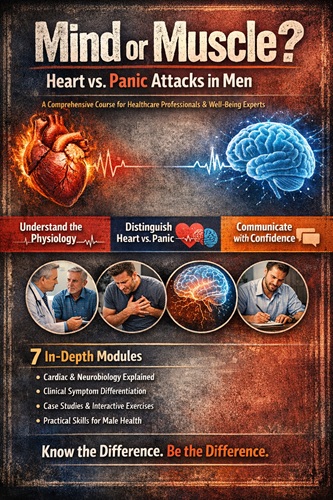
Have you ever wondered whether that racing heart and crushing chest tightness is your heart crying out for help or your nervous system stuck in overdrive? You are not alone. Every year, thousands of men in emergency rooms worldwide sit in the exact same uncertainty. This intermediate-level course cuts through the confusion with warmth, rigour, and real-world clarity.

Mind or Muscle? Heart vs. Panic Attacks in Men is a richly detailed, neuroscience-informed training resource designed for healthcare professionals, allied health workers, mental health practitioners, fitness coaches, and curious, health-conscious men. Over seven comprehensive modules, you will explore the cardiovascular and neurobiological underpinnings of both conditions, master clinical symptom differentiation, navigate diagnostic algorithms, and develop compassionate communication skills tailored to male health presentations.

The course blends academic rigour with accessible language, real-life case vignettes, engaging activities, and reflection prompts. Whether you sit at the bedside, behind a coaching desk, or at your own kitchen table wanting to understand your body better, this course meets you where you are and takes you somewhere genuinely valuable.

By the end of this course, you will not only know the difference between a heart attack and a panic attack, but you will understand WHY the difference exists at every level: from the cellular physiology of the myocardium to the firing patterns in the limbic system. That understanding will make you a better clinician, a better coach, a better advocate, and a healthier man.

.

Show More

What Will You Learn?

  • • The core definitions, epidemiology, and underlying physiology of myocardial infarction and panic disorder in adult men.
  • • How the autonomic nervous system, the HPA axis, and the limbic system contribute to both cardiac and anxiety presentations.
  • • A detailed comparison of symptom onset, quality, location, duration, and associated features across both conditions.
  • • Diagnostic algorithms, emergency protocols, ECG interpretation basics, and troponin timelines for suspected cardiac events.
  • • Psychological screening tools, breathing regulation techniques, and evidence-based acute management of panic attacks.
  • • How male socialisation patterns, stigma, and health-seeking behaviour influence presentation and disclosure.
  • • Compassionate, jargon-free communication strategies for use with male patients across clinical and coaching contexts.
  • • How comorbid conditions such as hypertension, depression, and sleep apnoea increase diagnostic complexity.
  • • A framework for building health literacy and personal emergency action plans for men.

Course Content

MODULE 1: Cardiovascular Physiology and the Stress Response
Module Overview Duration: Approximately 80 minutes | 3 Lessons In this foundational module, you will explore how the heart works at a cellular and systems level, how the body's stress response is orchestrated by the nervous system, and why these two systems can produce symptoms that look and feel remarkably similar. By the end of Module 1, you will understand the structural difference between a stressed but intact heart and a heart in infarction, and you will be equipped with the neurobiological vocabulary you need for the rest of the course. Learning Objectives: Module 1 • Describe the anatomy and function of the coronary arteries and myocardium. • Explain the cellular mechanism of myocardial infarction, including atherosclerosis, plaque rupture, and ischaemia. • Define the autonomic nervous system and its sympathetic and parasympathetic branches. • Describe the hypothalamic-pituitary-adrenal (HPA) axis and the catecholamine cascade. • Explain how an acute stress response produces cardiovascular symptoms without structural cardiac damage.

  • Lesson 1.1: The Heart as an Electromechanical Pump
  • Lesson 1.2: The Neurobiology of Stress and the Autonomic Nervous System
  • Lesson 1.3: From Stress Response to Pathology – Bridging the Two Conditions
  • Module 1 Summary: Key Takeaways
  • Questions 1
  • Activity 1: Your Stress Response Log
  • Activity 2: Coronary Artery Mapping

MODULE 2: Symptom Comparison and Clinical Presentation
Module Overview Duration: Approximately 90 minutes | 3 Lessons In Module 2, you will go deep into the lived experience and clinical presentation of both conditions. You will learn to compare chest pain quality, radiation patterns, associated symptoms, and temporal features with the precision of a skilled clinician. Case vignettes will bring the academic content to life, helping you practise pattern recognition in realistic, human scenarios. Learning Objectives: Module 2 • Characterise the quality, location, radiation, timing, and severity of chest pain in STEMI, NSTEMI, and panic attacks. • Identify associated symptoms that suggest cardiac versus psychological aetiology. • Explain why symptoms in men may differ from the textbook presentations and from those seen in women. • Apply the OPQRST mnemonic to structured symptom assessment. • Use case vignettes to practise differential symptom analysis.

MODULE 3: Neurobiological Mechanisms of Panic and Cardiac Events
Module Overview Duration: Approximately 85 minutes | 3 Lessons Module 3 takes you deeper into the brain. You will explore the neural architecture of fear, threat perception, and the autonomic regulation of the heart. Understanding WHY panic attacks feel so cardiac in nature, and why cardiac events can mimic psychological ones, is both intellectually fascinating and practically essential for anyone working at the mind-body interface. Learning Objectives: Module 3 • Describe the role of the amygdala, prefrontal cortex, and insula in threat perception and interoception. • Explain the neurobiological basis of panic disorder including fear conditioning and interoceptive hypersensitivity. • Identify how catecholamine surges affect cardiac physiology during acute panic. • Describe the cardiac consequences of sustained sympathetic overdrive, including arrhythmogenesis and stress cardiomyopathy. • Explain the concept of interoceptive awareness and its relevance to both conditions.

MODULE 4: Diagnostic Evaluation and Treatment Pathways
Module Overview Duration: Approximately 90 minutes | 3 Lessons Module 4 is your clinical toolkit. You will master the diagnostic algorithms, investigations, and emergency protocols for suspected MI, and contrast them with the psychological screening tools and acute management strategies for panic attacks. Practical, step-by-step guidance is provided throughout. Learning Objectives: Module 4 • Apply the MONA protocol and describe the rationale for each component in suspected acute MI. • Interpret the key ECG changes associated with STEMI and NSTEMI. • Understand the role and timing of high-sensitivity troponin assays in cardiac diagnosis. • Describe the validated screening tools for panic disorder and acute anxiety. • Explain evidence-based acute management strategies for panic attacks in clinical and non-clinical settings.

MODULE 5: Comorbidities, Risk Factors, and Diagnostic Complexity
Module Overview Duration: Approximately 80 minutes | 3 Lessons No man is a single-condition island. Module 5 explores the web of comorbidities that complicate differential diagnosis between MI and panic attacks, including hypertension, diabetes, sleep apnoea, depression, and substance use. Understanding these overlapping risk landscapes makes you a more complete, nuanced clinician or health practitioner. Learning Objectives: Module 5 • Identify the major cardiovascular risk factors in men and explain their pathophysiological contribution to MI risk. • Describe how comorbid depression, anxiety, and sleep apnoea increase both cardiac and psychological vulnerability. • Explain the relationship between substance use (alcohol, caffeine, cocaine) and both cardiac events and panic attacks. • Recognise how metabolic syndrome creates a shared risk environment for cardiac disease and mental health disorders. • Apply a holistic risk stratification approach to men presenting with chest pain.

MODULE 6: Communication Strategies and Male-Centred Care
Module Overview Duration: Approximately 75 minutes | 3 Lessons Module 6 shifts from physiology to relationship. The most accurate diagnostic knowledge is ineffective if it cannot be communicated with empathy, respect, and cultural sensitivity. In this module, you will learn how to engage men in conversations about health, how to take a non-judgmental history, how to deliver difficult news, and how to build the kind of therapeutic trust that keeps men engaged in their own care. Learning Objectives: Module 6 • Explain the key sociocultural factors that influence men's health-seeking behaviour and symptom disclosure. • Apply motivational interviewing principles to engage men in honest health conversations. • Use clear, jargon-free language to explain MI versus panic attack diagnoses to male patients or clients. • Demonstrate reassurance techniques that validate without minimising and inform without alarming. • Design collaborative care conversations that respect male autonomy and engage men as active participants in their health.

MODULE 7: Case Studies, Integration, and Real-World Application
Module Overview Duration: Approximately 85 minutes | 3 Lessons Module 7 is where everything comes together. Through three rich, detailed case studies, you will apply everything you have learned, integrating cardiovascular physiology, neurobiology, symptom analysis, diagnostic reasoning, comorbidity assessment, and communication strategies into cohesive, real-world clinical thinking. You will also build a personal competency framework and create your own application plan. Learning Objectives: Module 7 • Apply integrated diagnostic reasoning to complex, ambiguous chest pain case presentations. • Identify the clinical decision points at which MI versus panic can be differentiated in each case. • Critique communication strategies used in each case and propose improvements. • Reflect on personal learning and identify areas for continued professional development. • Construct a personalised application plan for the clinical or coaching setting.

Earn a certificate

Add this certificate to your resume to demonstrate your skills & increase your chances of getting noticed.
selected template

Student Ratings & Reviews

No Review Yet
No Review Yet
Scroll to Top