
Understanding Temporary Drawing and Cancer Risk

About Course

Understanding Temporary Drawing and Cancer Risk
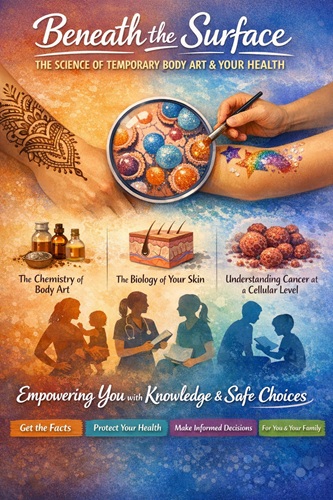
Have you ever had a henna tattoo at a festival, let your child get a glitter design at a fair, or used a temporary transfer tattoo from a toy shop? These everyday experiences seem harmless and fun, but there is a growing body of scientific research asking important questions about what these products contain and what they may do to the human body over time.

This course takes you on a warm, engaging, and science-backed journey into the world of temporary body drawing, exploring the chemistry of the products used, the biology of human skin, the basics of how cancer develops at a cellular level, and how to make informed, safe choices for yourself and the people you care for.

This is not a course designed to frighten you. It is a course designed to empower you. You will leave with real knowledge, practical tools, and a deeper understanding of your body and the products you use on it. Whether you are a parent, a health professional, an educator, a student, or simply a curious human being, this course meets you exactly where you are.

We’d love your feedback

If this course supported your growth or sparked new insights, please take a moment to leave us a review on Google.

Your words help others find us, and help us keep creating meaningful, stigma-free learning experiences.

Leave a review here


Show More

What Will You Learn?

  • 1. Define what temporary body drawing is and identify its main types and applications
  • 2. Explain the basic structure and function of human skin, including its neurobiological role
  • 3. Identify common chemical ingredients found in temporary drawing products and explain their potential effects on the body
  • 4. Describe the fundamental biological process by which cancer develops at a cellular level
  • 5. Distinguish between proven carcinogens, probable carcinogens, and substances under investigation in the context of temporary drawing
  • 6. Apply a basic risk assessment framework when evaluating temporary drawing products
  • 7. Demonstrate practical safety strategies for minimising exposure to potentially harmful substances
  • 8. Communicate key findings to others, including children, clients, or colleagues, in clear and accessible language

Course Content

MODULE 1: WHAT IS TEMPORARY BODY DRAWING?
Module Introduction: Welcome to Module 1! This is where our journey begins, and it is a great place to start because we are going to look at something you have probably already encountered, without giving it too much thought. Temporary body drawing is everywhere. From henna nights before a wedding to face painting at a school fair, from glitter tattoos at the beach to transfer tattoos in a cereal box. Before we can understand any potential health concerns, we need to understand exactly what we are talking about. So let us dive in with curiosity and excitement! Module Learning Objectives: By the end of this module, you will be able to: • Define temporary body drawing and distinguish it from permanent tattooing • Identify the five main categories of temporary body art • Explain the cultural and historical context of body drawing practices • Describe where and how temporary drawing products are used in everyday life • Begin to ask critical questions about what these products contain

  • LESSON 1.1: DEFINING TEMPORARY BODY DRAWING
  • LESSON 1.2: THE HISTORY AND CULTURE OF TEMPORARY BODY ART
  • LESSON 1.3: HOW THE TEMPORARY BODY ART MARKET WORKS TODAY
  • Activity 1.1: The Body Art Audit
  • Activity 1.2: Product Investigation Exercise
  • Activity 1.3: Cultural Mapping Activity
  • Activity 1.4: The “What Would You Do?” Scenario
  • Question 1

MODULE 2: THE BIOLOGY OF SKIN AND THE NERVOUS SYSTEM
Module Introduction: Welcome to Module 2! Now that we know what temporary body drawing is and where it comes from, it is time to get up close and personal with the body itself. Specifically, we are going to look at the extraordinary organ that is your skin, and we are going to explore its relationship with your nervous system. This module is where the neuroscience basics come in, and I promise it is going to be fascinating. Your skin is so much more than a surface. It is an intelligent, responsive, communicating system, and understanding it is key to understanding everything that follows. Module Learning Objectives: By the end of this module, you will be able to: • Describe the three main layers of human skin and their functions • Explain how substances applied to the skin can penetrate deeper layers • Identify the role of the skin as a sensory and neurobiological organ • Describe the basic function of keratinocytes, melanocytes, and Langerhans cells • Explain the concept of percutaneous absorption and its relevance to chemical exposure

MODULE 3: CHEMISTRY OF TEMPORARY DRAWING PRODUCTS
Module Introduction: Welcome to Module 3! This is the module where we roll up our sleeves and look at what is actually inside these products. Do not worry if chemistry was not your favourite subject at school: we are going to approach this with real-world relevance and keep things as clear and practical as possible. By the end of this module, you are going to be genuinely equipped to look at an ingredient label and make sense of what you are reading. Module Learning Objectives: By the end of this module, you will be able to: • Identify the key chemicals found in temporary drawing products • Explain the health concerns associated with para-phenylenediamine (PPD) • Describe the difference between contact dermatitis and systemic toxicity • Identify other concerning ingredients found in body paints, glitter adhesives, and transfer tattoo inks • Explain what "sensitisation" means in the context of chemical exposure

MODULE 4: UNDERSTANDING CANCER AT THE CELLULAR LEVEL
Module Introduction: Welcome to Module 4! This is perhaps the most science-intensive module in the course, and it is also one of the most important. The word "cancer" can feel frightening, but knowledge is the antidote to fear. In this module, we are going to demystify cancer completely. We are going to look at what it actually is at the cellular level, how it develops, what causes it, and how the chemicals we have been studying relate to the cancer process. By the end of this module, you will understand cancer better than most of the general population, and that understanding will completely change how you relate to risk information. Module Learning Objectives: By the end of this module, you will be able to: • Define cancer and describe its fundamental characteristics • Explain the cell cycle and how errors in cell division contribute to cancer development • Describe the role of oncogenes, tumour suppressor genes, and DNA repair mechanisms • Explain the terms carcinogen, mutagen, and teratogen and distinguish between them • Describe the IARC classification system for carcinogens • Connect chemical exposure through temporary drawing products to the mechanisms of cancer development

MODULE 5: SAFETY, PREVENTION, AND EMPOWERED CHOICES
Module Introduction: Welcome to Module 5, our final module! You have covered an enormous amount of ground. You now understand what temporary body drawing is, how skin works, what chemicals are concerning, and how cancer develops. But knowledge without action is like a map without a journey. This module is all about what we DO with what we know. It is warm, practical, forward-looking, and deeply empowering. Let us finish strong! Module Learning Objectives: By the end of this module, you will be able to: • Apply a systematic safety assessment framework to any temporary drawing product • Design and communicate age-appropriate safety guidelines for temporary body drawing • Identify and respond appropriately to allergic reactions and chemical skin injuries • Create a personal and professional action plan for informed decision-making around temporary body drawing • Communicate risk information effectively to diverse audiences, including parents, children, and professionals

Earn a certificate

Add this certificate to your resume to demonstrate your skills & increase your chances of getting noticed.

selected template

Student Ratings & Reviews

No Review Yet
No Review Yet
Scroll to Top