
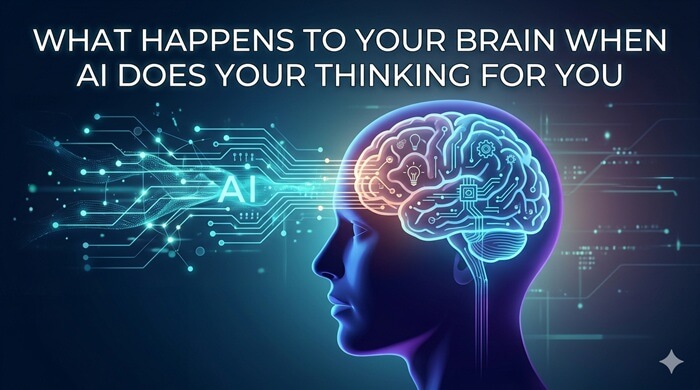
What Happens to Your Brain When AI Does Your Thinking For You
Let’s be honest about how it starts.
You open a document, face a blank page, and feel that familiar low-grade dread. Before you’ve written a single sentence, you flip to an AI tool and ask it to get you started. It generates something in seconds, not perfect, but workable. You breathe a small sigh of relief. Problem solved.
Or you’re in the middle of a problem that needs untangling. Instead of sitting with it, turning it over, following it to its edges, you paste it into a chat window and ask for a solution. One arrives quickly. You move on.
None of this is wrong. AI is genuinely useful, and using it doesn’t make you lazy or intellectually weak. But there’s a question worth sitting with, one that neuroscience has a surprisingly direct answer to:
What happens to your brain when it stops being asked to do the hard parts?
The answer is important, not as a warning, but as useful information about how your brain works, what it needs, and how to make sure that in gaining a powerful tool, you don’t quietly lose something more valuable.
The Brain Is an Expert at Outsourcing
One of the most fundamental principles of how the brain works is efficiency. Your brain consumes roughly 20 percent of your body’s energy despite being only about 2 percent of its weight. Given that metabolic cost, it is constantly looking for ways to do more with less, to automate, delegate, and offload wherever possible.
This is called cognitive offloading, and it’s not a flaw. It’s one of the brain’s most sophisticated capacities. We offload to our phones (so we don’t have to remember phone numbers), to calendars (so we don’t have to track time), to written notes (so we don’t have to hold everything in working memory). Every time we externalise something the brain would otherwise have to manage internally, we free up cognitive resources for other things.
AI is simply the most powerful offloading tool we’ve ever had access to. It can handle not just storage and retrieval, but the generative, combinatory work that used to require genuine cognitive effort, drafting, planning, analysing, and synthesising.
And here is where it gets interesting, neurologically. Because the brain doesn’t just offload passively, it actively adjusts. When a cognitive task is consistently handled externally, the neural pathways associated with doing that task internally begin to weaken. Not immediately, and not irreversibly, but measurably, over time.
The brain learns, in the most literal sense, that it doesn’t need to do that anymore.
Use It or Lose It – Applied to Thinking
The use-it-or-lose-it principle is one of the most well-established findings in neuroscience. Neural pathways that are regularly activated stay strong and efficient. Pathways that fall into disuse become less accessible; the brain, ever practical, reallocates resources toward what’s actually being used.
This principle is usually discussed in the context of physical skills or memory. But it applies equally to cognitive skills, to critical thinking, to creative problem-solving, to the capacity to sit with ambiguity and work through it without reaching for an answer.
These are not abstract virtues. They are skills with a genuine neurological substrate. They are built through practice, specifically, through the repeated experience of encountering a hard problem and working through it yourself, even imperfectly, even slowly.
When AI consistently steps in before that work happens, the practice doesn’t accumulate. The pathways don’t strengthen. And over time, what felt like a useful shortcut begins to feel like the only route available, not because you’ve become less capable, but because the capacity for the longer route has quietly atrophied from disuse.
This is worth taking seriously, not with alarm, but with the same practical attention you’d give to any skill you want to keep sharp.
The Blank Page Is Not the Enemy
There’s a particular moment that AI has become very good at rescuing us from: the discomfort of not knowing where to start.
That discomfort has a neurological name and a neurological purpose. When you sit with an unresolved problem or an empty page, your brain activates what’s known as the default mode network, a set of regions that become more active, not less, when you’re not focused on an external task. This is the network associated with mind-wandering, self-reflection, and crucially, the spontaneous generation of novel connections between ideas.
In other words, the apparently unproductive experience of staring into space, feeling stuck, wondering where to begin, that is your default mode network doing something genuinely valuable. It is searching, associating, making the kind of lateral connections that don’t emerge from linear, directed thinking. Many of the best ideas, the unexpected angles, the surprising solutions, the creative leaps, come from this network, in exactly these moments of apparent blankness.
When AI fills that space before the default mode network has had time to work, we bypass the process entirely. We get an answer faster. But we may also miss the answer that was forming, slowly and invisibly, in the discomfort we didn’t stay with long enough.
This doesn’t mean you should never use AI to get started. It means it’s worth asking, before you do: have I given my own brain a moment to work on this first? Even five minutes of genuine, unaided struggle before reaching for assistance can make a significant difference, both in the quality of what emerges and in keeping that creative capacity exercised.
What AI Cannot Carry – and Why That Matters
There’s something else worth naming, which sits slightly outside of neuroscience but is deeply relevant to anyone who creates, communicates, or leads.
AI is extraordinarily good at pattern synthesis, at identifying what has been said, written, and thought across vast amounts of existing content, and recombining it in new configurations. What it cannot access is the thing that makes your thinking yours: your specific lived experience, your particular way of seeing, the idiosyncratic connections your brain has built across your unique history of reading and thinking and being in the world.
When you write something entirely from within yourself, when you struggle to articulate an idea that doesn’t quite have words yet, when you reach for an analogy from your own experience, when you work through a problem in your own voice, you are drawing on a genuinely irreplaceable perspective. No AI, trained on the output of millions of other people, can produce that. It can approximate a voice. It cannot generate an unrepeatable one.
This matters practically. In a world where AI-generated content is becoming ubiquitous, the work that carries real human thinking, the specific, the personal, the hard-won, is not becoming less valuable. It is becoming more so. The differentiator, increasingly, is not how efficiently you can produce something, but how distinctly human the thinking behind it is.
Which means the cognitive capacities that AI most readily replaces are precisely the ones most worth protecting.
Using AI Well – A Brain-First Approach
None of this is an argument against AI. It’s an argument for using it with some awareness of what’s happening in your brain when you do.
A few principles that hold up neurologically:
Engage your own thinking before you outsource it
Before you ask AI to draft, generate, or solve, give your brain a few minutes with the problem first. Write your own rough first paragraph. Sketch your own initial response. Let the default mode network run. What you bring to the AI prompt after that process will be richer, more distinctly yours, and more likely to produce something worth using.
Use AI to challenge your thinking, not replace it
Some of the most useful applications of AI are the ones that push back rather than produce, asking it to find the holes in your argument, to steelman the opposite position, to identify what you might be missing. This keeps your critical faculties active and engaged rather than in passive receipt of an answer.
Stay the final authority on your own work
Whatever AI produces passes through you before it goes anywhere. Not as a light edit for tone, but as a genuine critical review, for accuracy, for alignment with your values, for the specific contextual judgements that only a human being with knowledge of the full situation can make. This isn’t just good practice for quality. It’s how you keep the evaluative and ethical muscles of your brain from atrophying too.
Notice when relief becomes a reflex
The most useful signal to pay attention to is your own comfort level with cognitive discomfort. If the idea of sitting with a blank page for five minutes feels genuinely intolerable, if reaching for AI has become the first move rather than a considered one, that’s worth noticing. Not with judgment, but with curiosity. The discomfort you’re avoiding may be exactly where the good thinking lives.
A Tool That Works Best When You’re Still Working Too
AI is not going away, and there’s no good reason to pretend otherwise or to use it reluctantly. It is a genuinely extraordinary tool, and the people who learn to use it thoughtfully will have real advantages over those who don’t.
But the brain that uses AI well is not the brain that has outsourced its hardest work. It’s the brain that stays curious, stays engaged, stays willing to sit with difficulty long enough to develop its own thinking, and then uses AI to extend, challenge, or refine what it has already built.
Your cognitive capacity is not a fixed resource to be conserved. It is a living system that grows stronger with use and quieter without it. The question to carry into every interaction with AI is a simple one:
Am I using this to think better, or to think less?
The answer to that question, repeated daily, is what determines whether AI becomes a lever for your intelligence, or a quiet substitute for it.