

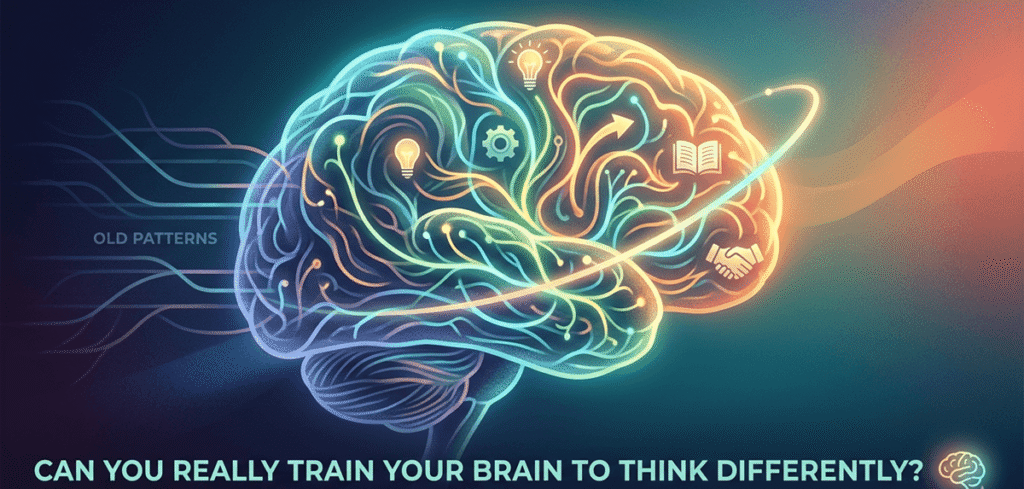
Can You Really Train Your Brain to Think Differently? Yes, And You’re Already Built for It
“This is just how I think.”
It’s a thought lots of people carry quietly. Maybe you’ve told yourself you’re not a creative person. Or that you always catastrophise. Or that you see things a certain way and, well, that’s just… you. It feels less like a habit and more like a fact about who you are.
And honestly? That feeling makes complete sense. When you’ve thought a certain way for years, decades, even, it stops feeling like a pattern and starts feeling like a personality. Like something you were handed, not something you built.
But here’s what the neuroscience actually shows: the way you think isn’t a fixed feature of your brain. It’s a pathway. And pathways can be redirected.
This post is for anyone who’s ever wondered, maybe with a little doubt in the question, whether they can actually change the way their mind works. The short answer is yes. The longer answer is worth understanding.
Why Your Thinking Feels So Permanent
When you repeat a thought pattern often enough, your brain gets efficient at it. Neurons that fire together, wire together. You may have heard that phrase before. What it means in practice is that your brain builds increasingly well-worn routes for processing certain experiences.
Think of it like a path through a field. The first time you walk it, you’re pushing through grass. Walk it a hundred times, and it becomes a clear track. Walk it a thousand times, and it becomes the obvious route, the one you take without thinking.
Your thinking patterns work the same way. When you habitually interpret criticism as rejection, or scan a room for what could go wrong, or default to “I can’t” before “I’ll try”, your brain isn’t malfunctioning. It’s being efficient. It’s taking the path it knows.
The problem isn’t that your brain is broken. It’s very, very good at repetition.
So, Can You Actually Train Your Brain to Think Differently?
Yes. And the scientific term for this is neuroplasticity.
Neuroplasticity is your brain’s capacity to reorganise itself, forming new connections, weakening old ones, and building entirely new ways of processing experience. For a long time, scientists believed this capacity faded significantly after childhood. We now know that’s not true.
Research in cognitive neuroscience has shown that the adult brain retains meaningful plasticity throughout life. The prefrontal cortex, the part of your brain most responsible for reasoning, perspective-taking, and decision-making, is particularly responsive to deliberate practice and new experience.
What this means for you: the neural pathways that carry your current thinking patterns are not permanent infrastructure. They’re more like habits of the mind. And habits, with the right approach, can be changed.
Worth noting: this is distinct from simply learning new information, which we’ve explored in other posts. What we’re talking about here is shifting the actual lens through which you see and interpret things. That’s a different, and arguably deeper, kind of brain work.
The Thinking Patterns That Feel Most Stuck
Some thought patterns are especially resistant to change, not because they’re hardwired, but because they’re deeply reinforced. A few of the most common ones:
The “I’m just not that kind of person” pattern
This one’s particularly tricky because it masquerades as self-awareness. “I’m not creative.” “I’m a pessimist.” “I don’t handle change well.” These feel like honest assessments, but they’re often conclusions drawn from old evidence, evidence collected by a younger version of you, in a different context, with far less information.
The threat-detection default
Some brains have been trained, often through difficult experiences, to scan constantly for what could go wrong. The amygdala, your brain’s threat-detection centre, can become hyperresponsive over time. This isn’t a weakness. It’s an adaptation. But it is something that can be gradually recalibrated.
The “this is just how I process things” story
There’s a version of self-knowledge that’s genuinely useful, and then there’s a version that functions as a ceiling. Knowing your tendencies is valuable. Believing they’re immovable is where it gets costly.
What Changing Your Thinking Actually Looks Like
Here’s what matters: changing how you think doesn’t happen through willpower or positive self-talk alone. The brain doesn’t respond to “just think differently.” It responds to repeated new experience that builds new pathways over time.
A few things that neuroscience tells us actually move the needle:
Cognitive reappraisal, the practice of consciously reframing how you interpret an event, has been shown to create measurable changes in how the brain processes emotional information. It’s not toxic positivity. It’s a trained skill that reshapes the neural response over time.
Intentional exposure to new perspectives, reading, conversation, and experiences that genuinely challenge your existing view creates new associative pathways. Your brain literally builds new connections when it encounters ideas it hasn’t processed before.
Metacognition, the practice of thinking about your thinking, activates the prefrontal cortex and creates just enough distance between you and your automatic thoughts to begin examining them. That gap is where change starts.
Consistent, low-pressure repetition matters more than dramatic breakthroughs. The brain builds new pathways through repetition, not revelation. Small, steady practice tends to outlast intense but unsustained effort.
None of this is overnight work. But it is real work, and it produces real results.
The Part That Often Gets Missed
A lot of people try to change their thinking by fighting their current thoughts, suppressing them, arguing with them, or feeling ashamed of them. Neuroscience suggests this is mostly counterproductive. Thought suppression tends to amplify the very thoughts you’re trying to quiet.
What actually works better is building something alongside the old pattern, not just tearing the old one down. New pathways don’t erase old ones immediately; they gradually become stronger and more accessible until they’re the route your brain reaches for first.
This is why change can feel slow and nonlinear. You might have a week of thinking more flexibly, then fall back into an old pattern under stress. That’s not failure. That’s how brains work. Stress tends to pull us back to familiar pathways because those pathways are efficient. The goal isn’t to never fall back; it’s to shorten the time it takes to find your way back to the new route.
You’re Not Too Far Gone
If you’ve arrived here wondering whether the way you think is just… You, fixed, permanent, not up for debate, know that neuroscience has a clear answer: no.
The brain you have right now is the same brain that built the patterns you’re questioning. Which means it’s also the brain that can build something different.
You don’t need to overhaul everything at once. You don’t need a dramatic turning point. You just need to start walking a slightly different path, regularly enough that it begins to feel familiar.
That’s not wishful thinking. That’s how your brain is designed to work.