
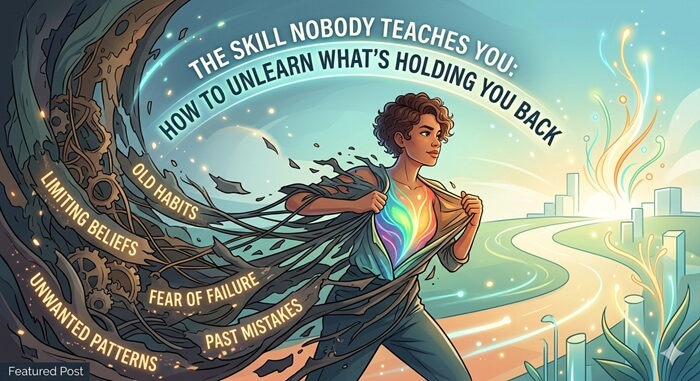
Agility, The Skill Nobody Teaches You: How to Unlearn What’s Holding You Back
When we talk about learning agility, we talk a lot about learning. How to learn better, faster, and more effectively. How to retain information, build new skills, and keep growing.
But there’s a companion skill that almost nobody talks about, one that’s arguably just as important, and considerably harder. It doesn’t have a module in school. It rarely comes up in professional development. And yet, without it, all the new learning in the world can only take you so far.
That skill is unlearning.
Not forgetting. Not wiping the slate clean. But the deliberate, often uncomfortable process of questioning what you already believe to be true, and being willing to let some of it go when the evidence suggests it no longer serves you.
In a world that keeps changing faster than any of us expected, the ability to unlearn and relearn may be the most future-proof skill you can develop. Here’s what’s happening in your brain when you do it, and how to get better at it.
What Is Learning Agility and Why Is Unlearning the Hard Part?
Learning agility is the capacity to learn from experience and apply that learning to new and unfamiliar situations. It involves staying curious, adapting quickly, reading changing contexts accurately, and updating your approach when what worked before stops working.
Most people are reasonably comfortable with the learning side of that equation. Adding new information, acquiring new skills, these feel like progress. They feel like growth.
Unlearning feels different. It feels like a loss.
Because when you unlearn something, you’re not just discarding information. You’re often challenging a belief you’ve held for years, a way of seeing a situation that has become automatic, an identity that has been built, at least partly, around knowing this thing. Your brain has invested significant energy in encoding it. The neural pathway is well-worn and efficient. Questioning it requires effort, and it can feel threatening in a way that picking up something new simply doesn’t.
This is why people who are excellent learners are not automatically excellent unlearners. They are different skills, drawing on different neurological capacities. And the second one needs deliberate practice.
What Happens in the Brain When You Unlearn
To understand why unlearning is hard, it helps to understand what learning actually does to the brain in the first place.
When you repeatedly think a thought, follow a process, or apply a belief, your brain strengthens the neural pathway associated with it. Neurons that fire together wire together; this is one of the foundational principles of neuroplasticity. The more you use a pathway, the more efficient it becomes. Eventually, it starts to run automatically, below conscious awareness.
This is enormously useful. Automation is how you drive a car while holding a conversation, or tie your shoes without thinking. The brain loves efficiency.
But that same efficiency becomes a problem when the pathway is outdated. When the belief was formed in a context that no longer exists. When the strategy made sense once, but the world has moved on. The brain doesn’t automatically flag these pathways for review. It just keeps running them, because they’re fast and familiar.
Unlearning requires you to do something the brain finds genuinely uncomfortable: interrupt an automatic process, hold it up to examination, and consciously choose a different route, repeatedly, until the new pathway becomes the stronger one.
This is where cognitive flexibility comes in. The prefrontal cortex, the brain’s centre for deliberate reasoning, perspective-taking, and decision-making, is what makes this possible. And like any other capacity, it can be trained.
The Three Movements of Learning Agility
Learning agility isn’t a single skill; it’s a cycle with three distinct movements, each requiring something slightly different from you.
1. Stay genuinely curious
Curiosity is the neurological on-ramp to learning agility. When you approach a situation with genuine curiosity, not performative openness, but real wondering, the brain releases dopamine in anticipation of discovery. This primes the prefrontal cortex for engagement and makes you more receptive to information that doesn’t fit your existing picture.
The practical version of this is simpler than it sounds. It’s the habit of asking, in situations that feel familiar: what might I be missing here? What would someone with a completely different background see that I don’t? What has changed since I last properly examined this assumption?
Curiosity doesn’t come naturally in high-pressure situations, when you’re stressed, or under threat, the brain narrows its focus rather than expanding it. This is why building curiosity as a genuine habit in low-stakes moments matters so much. You’re training the default setting, so it’s more available when you need it most.
2. Treat mistakes as neurological data
Every mistake your brain makes in a new situation is, neurologically, useful information. It’s the brain running an old pattern, noticing the mismatch, and, if you let it, beginning the process of updating.
The problem is that most of us have been trained to experience mistakes as evidence of inadequacy rather than as feedback. That response triggers the threat system, floods the brain with cortisol, and shuts down the prefrontal cortex, the very part of the brain you need to actually learn from the mistake.
Building learning agility means deliberately shifting the relationship with error. Not celebrating failure for its own sake, but cultivating the ability to pause after a misstep and ask: what did this reveal? What was I assuming that turned out to be wrong? What does this tell me about what needs updating?
Each time you do that, you’re strengthening the neural pathways associated with adaptive thinking and weakening the shame response that makes mistakes feel like something to hide rather than something to learn from.
3. Practise unlearning directly
This is the most demanding part, and the one that requires the most deliberate effort. It means sitting with an assumption you’ve held for a long time and genuinely asking: Is this still true?
Not rhetorically. Not as a thought exercise. But as a real inquiry, with real willingness to be changed by the answer.
A useful starting point is to identify the beliefs or approaches in your work or personal life that have become automatic, the things you do without thinking, the conclusions you reach before you’ve finished examining the evidence. Then apply a simple test: when did I form this belief? What was true about the world at that time? Is it still true now?
Some of what you find will still hold. Some of it will quietly surprise you. The point isn’t to destabilise everything you know, it’s to loosen the grip of certainty enough that new information can actually get in.
Why This Is Harder Than It Sounds and Why That’s Worth Acknowledging
Unlearning asks something of us that sits right up against our deepest psychological needs. We are wired for consistency. The brain builds its model of the world through pattern recognition, and it protects that model fiercely, because a coherent model feels safe, even when it’s wrong.
Challenging a deeply held belief about how work should be done, about what you’re capable of, about how people behave, about what success looks like, can feel genuinely threatening. It can produce anxiety, resistance, and a strong pull back toward the familiar.
This is especially true when the belief is tied to identity. When ‘I am someone who does it this way’ is woven into your sense of who you are, questioning the approach can feel like questioning yourself.
None of this means you’re doing it wrong. It means you’re human, and your brain is working exactly as it was designed to. The discomfort of unlearning isn’t a sign to stop. It’s usually a sign that you’re close to something worth examining.
Building the Habit Over Time
Learning agility isn’t built in a single session of reflection. It’s built through repeated small acts, the daily practice of noticing, questioning, and choosing differently, over time.
A few things that support that practice:
- Seek out people who think differently from you, and listen with the intention of understanding rather than countering
- When something doesn’t go as expected, pause before explaining it away, and ask what it might be telling you
- Revisit a belief or approach you haven’t examined in a while and apply the ‘is this still true?’ test
- Notice when you feel the pull toward certainty in an uncertain situation, that pull is often where the unlearning work lives
None of these is dramatic. None of them requires a workshop, a framework, or a personality overhaul. They require only a willingness to stay a little less certain than your brain would prefer, and to trust that the discomfort of not-knowing is where the growth actually happens.
The Most Valuable Thing You Can Know Is That You Might Be Wrong
We live in a time that rewards the appearance of certainty. Confidence is valued. Having the answer is valued. Admitting that what you knew yesterday might not hold today can feel like weakness.
But your brain knows better. It knows that the world keeps changing, that old maps don’t fit new territory, and that the person who can update their understanding is far better equipped than the person who cannot.
Learning agility, the full cycle of learn, unlearn, and relearn, is not a productivity hack or a professional development checkbox. It’s a way of staying genuinely open to life as it actually is, rather than as you once understood it to be.
That openness takes courage. It takes practice. And it takes the willingness to be, occasionally, a beginner again. Which, as it turns out, your brain finds quite wonderful, if you give it the chance.